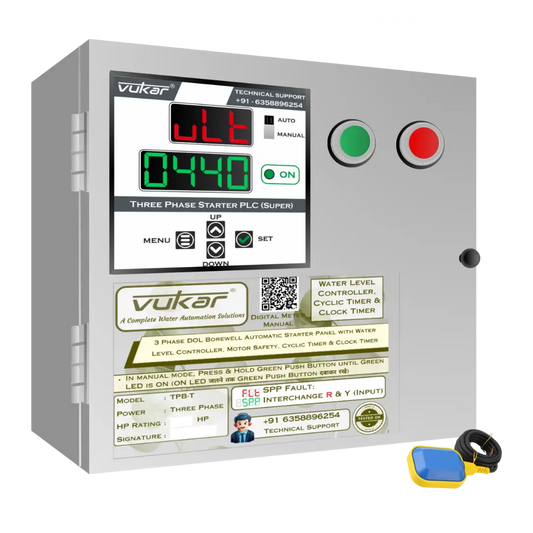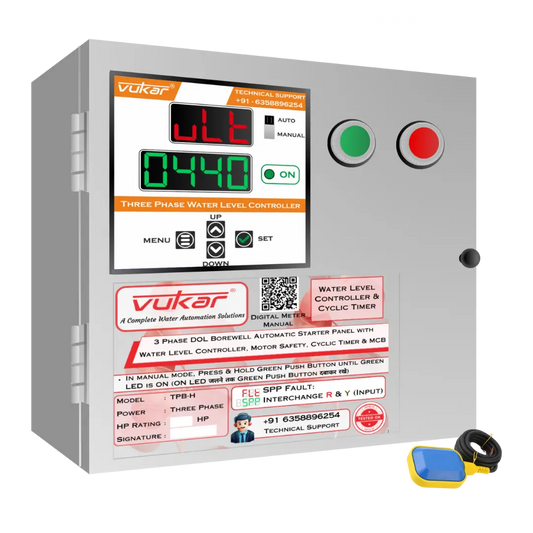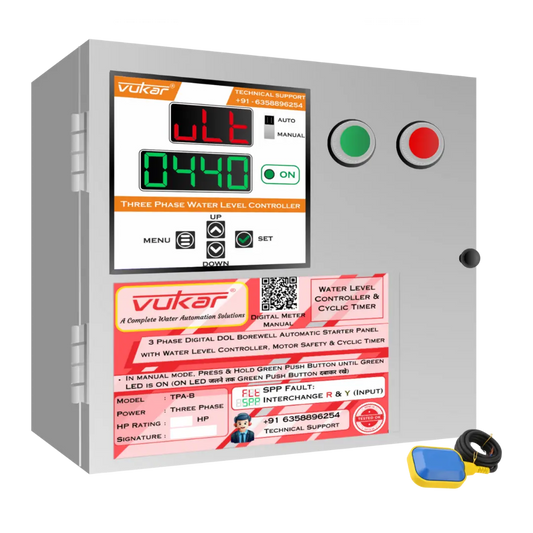

The Best Automatic Water Level Controller: Your Home's Water Manager
Mohit VekariaA correctly selected starter panel can disconnect a pump for the faults it is designed and configured to detect. It cannot guarantee uninterrupted water supply, prevent every motor failure or replace maintenance.

The Best Automatic Water Level Controller: Your Home's Smart Manager
Water level control is a separate model-dependent function. Confirm the compatible float or sensor, tank/source arrangement and stop/start sequence. An overhead-tank sensor does not confirm borewell recovery, and a timer is not a water-level sensor.
Why Your Home Needs More Than Just a Switch
It is 2 PM. You are at work. A thought suddenly strikes you: Did the municipal water come?
Did I miss the two-hour window to fill the sump? This constant, nagging anxiety is exhausting. In a place with unpredictable water and power, every drop feels precious. You need more than a switch. You need a responsible manager for your home water. You need an automatic water level controller.
The Fear of Resource Mis-management
Forgetting to turn the pump on is more than an inconvenience. It is a crisis in the making. A motor burning out from a voltage spike is more than a repair bill. It is a major, unexpected expense that disrupts your budget and your life.
Protection functions and their limits
In a tank-filling installation, a low-level signal can request a start and a high-level signal a stop, subject to the controller’s mode and interlocks. Source-water checking is a separate input or protection function. Confirm which tanks are monitored; no controller can create water during an empty source or power outage.
Use a sensor type and wiring arrangement approved for the exact controller and water conditions. Float switches can support automatic start and stop in suitable circuits; electronic probes are not universally more reliable. Test level response and inspect the sensor according to its instructions.
Compare exact models and documented functions
Compare the actual start/stop sequence, sensor compatibility, source-water interlock, voltage cutoff, output rating and restart behaviour. Check each function in the selected variant’s documentation. A float switch, level controller and motor-protection panel perform different jobs; a “smart” label does not guarantee all three.
Selection and commissioning checks
Before ordering, record the motor nameplate phase, voltage, HP/kW and rated current. Match the panel, contactor duty, overload adjustment range and enclosure to that motor and its installation. HP alone is not enough to confirm compatibility.
Demand Full Automation
Before enabling Auto mode, confirm what happens after power returns, a timer expires or a fault clears. Assess unattended-start hazards and the actual water-source conditions. Automatic starting does not remove inspection duties, and no universal restart delay suits every borewell.
Insist on Dry Run Protection
Dry-run detection may use a source-level input or a change in motor load, depending on the model. Current sensing is not a direct measurement of water level. Confirm the sensing method, settings, delay and restart sequence; a timer does not prove the borewell has recovered.
Verify Voltage Protection
Check the exact model’s voltage detection limits, trip delay and recovery behaviour. A voltage cutoff disconnects the motor under specified conditions; it is not a voltage stabilizer or a guarantee against every surge. Repeated trips require investigation, not bypassing protection.
full range of water level controller starter panels · single phase water level controllers for home tanks
Check for High-Quality Sensors
Use a sensor type and wiring arrangement approved for the exact controller and water conditions. Float switches can support automatic start and stop in suitable circuits; electronic probes are not universally more reliable. Test level response and inspect the sensor according to its instructions.
Look for Clear Indicators
A good system will have simple, easy-to-read LED lights. These should show you the status at a glance: "Pump On," "Tank Full," and critically, "Sump Empty" or "Voltage Fault."
Frequently Asked Questions (FAQ)
What is the best water level controller sensor?
Use a sensor type and wiring arrangement approved for the exact controller and water conditions. Float switches can support automatic start and stop in suitable circuits; electronic probes are not universally more reliable. Test level response and inspect the sensor according to its instructions.
How does a water tank controller protect my motor?
A correctly selected starter panel can disconnect a pump for the faults it is designed and configured to detect. It cannot guarantee uninterrupted water supply, prevent every motor failure or replace maintenance.
What is the main advantage of a microcontroller-based system?
Check the actual display, fault codes and history features provided by the selected model. A fault indication identifies a detected condition, not necessarily its root cause. Logging capacity and response times must come from the manual, not from the word “digital”.
Will this work with an unpredictable municipal water supply?
In a tank-filling installation, a low-level signal can request a start and a high-level signal a stop, subject to the controller’s mode and interlocks. Source-water checking is a separate input or protection function. Confirm which tanks are monitored; no controller can create water during an empty source or power outage.
Can I use any water sensor for tank?
Use a sensor type and wiring arrangement approved for the exact controller and water conditions. Float switches can support automatic start and stop in suitable circuits; electronic probes are not universally more reliable. Test level response and inspect the sensor according to its instructions.
Before you order
Choose from the documented model and installation requirements, then arrange qualified commissioning and ongoing checks. Confirm the warranty and support route before purchase. Automatic operation is a convenience, not a guarantee against faults or a substitute for maintenance.