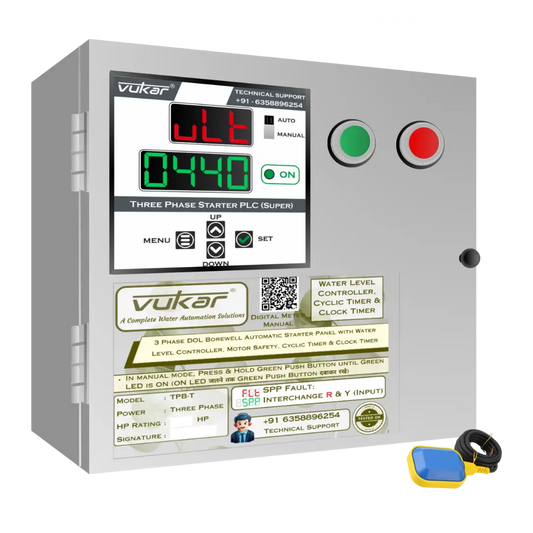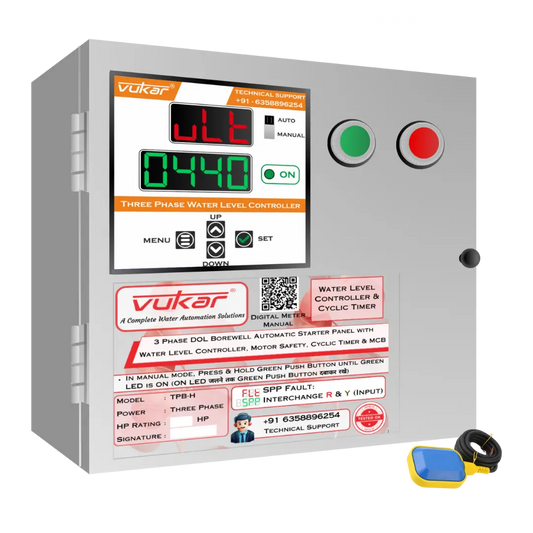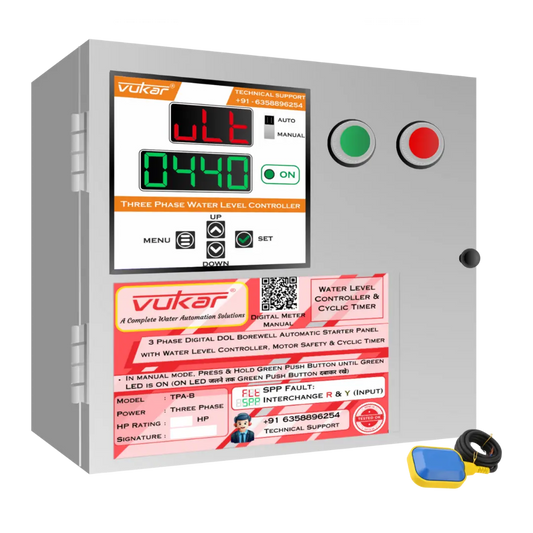

Automatic Water Pump Controller: Selection and Setup Guide
Mohit VekariaA correctly selected starter panel can disconnect a pump for the faults it is designed and configured to detect. It cannot guarantee uninterrupted water supply, prevent every motor failure or replace maintenance.

The Smart Automatic Motor Controller: Your Key to a Peaceful Home
Water level control is a separate model-dependent function. Confirm the compatible float or sensor, tank/source arrangement and stop/start sequence. An overhead-tank sensor does not confirm borewell recovery, and a timer is not a water-level sensor.
Beyond the Switch: The Logic of a True Automatic Water Pump Controller
"Did you remember to turn the pump on?" The words hang in the air. A spark for the day's first argument.
Later, a different anxiety hits you at work, "Did I remember to turn it off?" This constant, nagging worry about the water pump is exhausting. It wastes your time, your water, and your calm. You are searching for an automatic water pump controller, but you are really looking for a way to permanently delete one major stress from your life.
The Fear of the Inevitable Mistake
You live a busy life. It is not a matter of if you will forget the pump, but when. The consequences are always frustrating. You either wake up to an empty tank and a disrupted morning, or you come home to see water pouring from the roof.
Lurking behind it all is the expensive fear of your motor burning out because the underground tank ran dry. This is not just an inconvenience. It is a heavy mental burden you carry every single day.
Protection functions and their limits
In a tank-filling installation, a low-level signal can request a start and a high-level signal a stop, subject to the controller’s mode and interlocks. Source-water checking is a separate input or protection function. Confirm which tanks are monitored; no controller can create water during an empty source or power outage.
Use a sensor type and wiring arrangement approved for the exact controller and water conditions. Float switches can support automatic start and stop in suitable circuits; electronic probes are not universally more reliable. Test level response and inspect the sensor according to its instructions.
Compare exact models and documented functions
Compare the actual start/stop sequence, sensor compatibility, source-water interlock, voltage cutoff, output rating and restart behaviour. Check each function in the selected variant’s documentation. A float switch, level controller and motor-protection panel perform different jobs; a “smart” label does not guarantee all three.
Selection and commissioning checks
Before ordering, record the motor nameplate phase, voltage, HP/kW and rated current. Match the panel, contactor duty, overload adjustment range and enclosure to that motor and its installation. HP alone is not enough to confirm compatibility.
Demand Full Automation
Before enabling Auto mode, confirm what happens after power returns, a timer expires or a fault clears. Assess unattended-start hazards and the actual water-source conditions. Automatic starting does not remove inspection duties, and no universal restart delay suits every borewell.
Insist on Dry Run Protection
Dry-run detection may use a source-level input or a change in motor load, depending on the model. Current sensing is not a direct measurement of water level. Confirm the sensing method, settings, delay and restart sequence; a timer does not prove the borewell has recovered.
Verify Voltage Protection
Check the exact model’s voltage detection limits, trip delay and recovery behaviour. A voltage cutoff disconnects the motor under specified conditions; it is not a voltage stabilizer or a guarantee against every surge. Repeated trips require investigation, not bypassing protection.
Check for High Quality Sensors
Use a sensor type and wiring arrangement approved for the exact controller and water conditions. Float switches can support automatic start and stop in suitable circuits; electronic probes are not universally more reliable. Test level response and inspect the sensor according to its instructions.
Look for Clear Indicators
A good system will have simple, easy to read LED lights. These should show you the status at a glance: "Pump On," "Tank Full," and critically, "Sump Empty" or "Voltage Fault."
single phase water level controllers · starter panel comparison for single phase borewell pumps
Frequently Asked Questions (FAQ)
Will this really protect my motor from burning out?
A correctly selected starter panel can disconnect a pump for the faults it is designed and configured to detect. It cannot guarantee uninterrupted water supply, prevent every motor failure or replace maintenance.
Is this automatic motor on off system hard to install?
Installation and internal maintenance require a qualified electrician using the exact model diagrams. Safely isolate the supply and verify it is de-energized before electrical work. Check earthing, cable selection, circuit protection and commissioning; a stop button is not electrical isolation.
What does a water tank automatic controller cost?
Request a dated, model-specific quotation. Separate the pump, starter or controller, cable, pipework, accessories, delivery, taxes and installation charges. Confirm what is included before comparing totals; an undated brand-wide price range is not a current purchase quote.
Can I use any automatic water sensor?
Use a sensor type and wiring arrangement approved for the exact controller and water conditions. Float switches can support automatic start and stop in suitable circuits; electronic probes are not universally more reliable. Test level response and inspect the sensor according to its instructions.
Before you order
Choose from the documented model and installation requirements, then arrange qualified commissioning and ongoing checks. Confirm the warranty and support route before purchase. Automatic operation is a convenience, not a guarantee against faults or a substitute for maintenance.