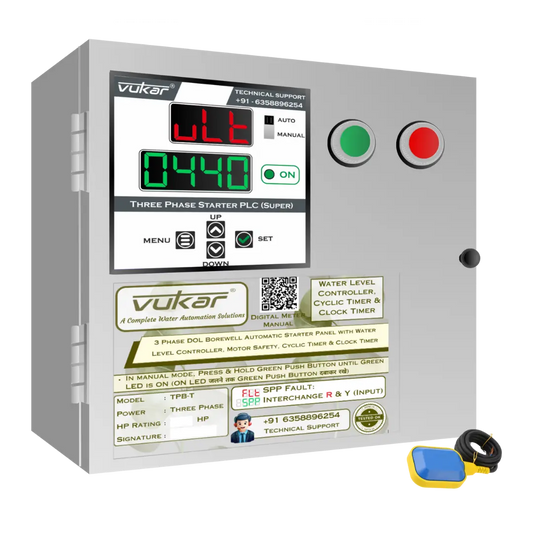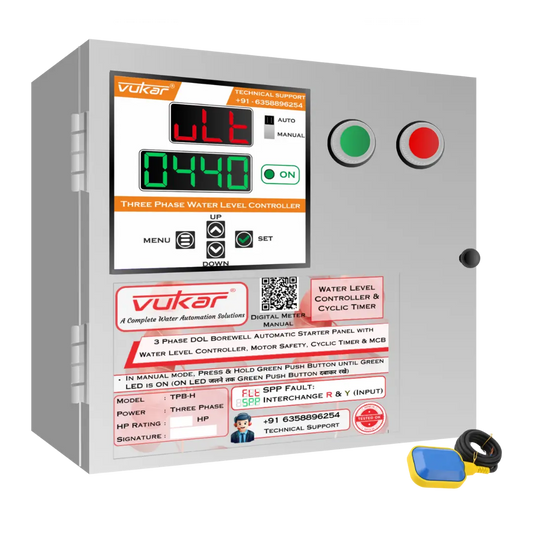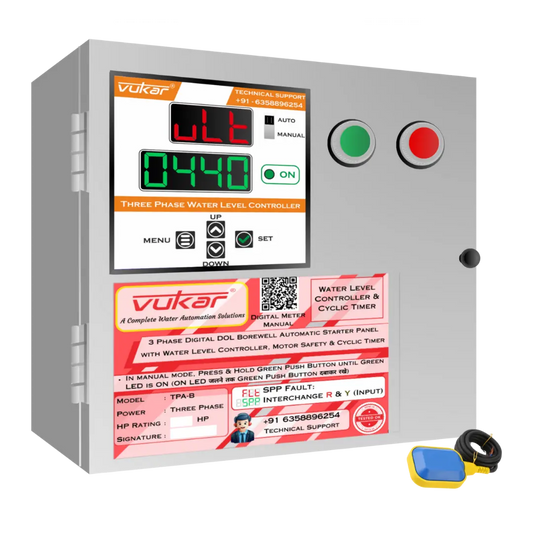

Recommended MOM-C Settings: Monoblock Run/Rest and Protection Limits
Mohit Vekaria
MOM-C recommended parameter settings are a commissioning record for your exact single-phase monoblock pump starter. Save the approved run and rest intervals for the installed MOM-C revision, copying the displayed timer labels, and record the motor’s approved protection limits and trip delays.

What belongs on the first-installation checklist?
A monoblock pump runs on a repeating cycle. During the first supervised cycle, note the time water starts to flow, the actual stop and whether the next permitted start matches what the installer explained. Keep the record with the pump’s permitted starts and normal supply conditions.
Write the panel model and variant as they appear on the label. Add the controller revision and the motor’s rated current and voltage from the nameplate or pump paperwork. The model tells you which functions the panel offers. The actual motor, supply, water source and operating mode determine the settings that belong in the record. Use the revision-matched instructions for the menu labels and save procedure. VUKAR product manuals and parameter reference
| Setting | What it does | What to record |
|---|---|---|
| OL / OLT | Overload current threshold and delay before an overload trip. | Approved amps (A) and seconds (s). |
| DR / DRT | Low-current threshold for dry-run detection and its own trip delay. | Approved amps and seconds. |
| HIU / LOU | High and low supply-voltage limits. | Both limits in volts (V). |
| ONT/OFT or RUN/RST | Run and rest lengths for the commissioned repeating cycle. | Both durations in minutes and the exact labels shown. |
Read current limits and delays as pairs
OL and DR are current limits. OLT and DRT are delays. With overload protection, the controller looks for current above the approved overload limit for the associated time. With dry-run protection, it looks for current below its approved threshold for the corresponding time. A short change in the current reading and a continuing condition tell the controller different things. Record the limit and delay together so the next installer can see both parts of the decision.

Keep the two voltage limits in the same record, with HIU for the upper limit and LOU for the lower limit. A voltage shown on the front display is the reading at that moment. Write a measured reading and a saved limit in different fields. If a protection trip repeats, note the displayed indication and the conditions around the stop so an installer can investigate the motor, supply or water source.
Have a qualified installer choose protection values using the actual motor and supply. Values from a different pump or controller revision can mislead even when the model name looks familiar. Ask the installer to record who approved the final limits and the date they were set. For wiring and work inside the enclosure, use a licensed electrical contractor and have the supply isolated and verified dead. Central Electricity Authority safety regulations

VUKAR product
MOM-C Single-Phase Starter Panel
For compatible monoblock pumps. See the product gallery and model features for monoblock run/rest and motor protection.
View MOM-CMonoblock run/rest and motor protection
Some revisions identify the run/rest pair as ONT/OFT and others as RUN/RST. Read the exact units and labels on your panel. Keep the elapsed cycle record beside the nameplate current and the approved values, so a later change of pump does not erase the original basis for the settings.
The pair can be labelled ONT/OFT or RUN/RST, depending on the controller revision. In a commissioned repeating cycle, record both run and rest in minutes. Observe a complete run, the normal stop, the rest period and the next permitted start. Use the pump maker’s operating limits and the installer’s observations of water delivery when choosing the cycle. If another mode uses a time differently, record that mode separately.

Keep the other applicable values as commissioned
Keep the documented defaults for the exact controller revision or the values the installer already commissioned. If TRQ appears on your panel, leave its starting torque time at that approved value. Keep current-sensor selection, marked CTS where applicable, and current or voltage calibration as commissioned. Those values belong with the installed hardware and measurements. Have the installer review changes using the matching instructions.
The approved restart settings may include a fault delay, memory after an outage or lockout behavior. Ask the installer to write down which options apply and what can happen after a supply interruption or fault. Keep the recorded mode and labels with the values so they still make sense at the next service visit.
Write down what happened during the watched run
If the pump stops early or water delivery changes, record the elapsed run time and any fault indication. The installer can compare those events with the saved cycle and check the pump’s water supply before changing the timings.

Keep three things together for handover. First, identify the panel variant, revision, motor and water source. Second, copy the saved settings and units, including the mode that was tested. Third, write when the test started and stopped, what the display showed and any unexpected event. Date the record and add the installer’s name. This gives you a baseline if a motor, sensor or water source changes later.
If the values already in the panel and the settings on an old service sheet differ, keep both records until the installer has identified the current approved set. A note such as “read from panel” or “approved after test” tells you which numbers were observed and which ones were accepted for the installation. Leave a missing unit or value blank until it can be confirmed.
When reporting a problem, send the panel model and revision, motor rating, current mode, display code and the time of the event. Include the saved timer or protection setting that relates to the event and note any recent change in the installation. VUKAR technical support
Review the record again after the pump has worked under its usual conditions. Note any difference between the first test and later operation, including a change in flow, demand or the supply. Keep that observation as a separate dated entry. If an installer changes a setting, keep the reason for the change and the result of the next supervised run with the new record.
If you inherit the installation, identify the existing panel and pump before relying on a note left by the last owner. Find out whether the equipment was serviced or replaced after the note was written. Ask the installer to review the existing record alongside the installed hardware and to explain any change before accepting a new setting.
For a repeating cycle, record the first normal stop and the next permitted start on separate lines. If the source, supply or mode changed in between, write that alongside the elapsed time so the observations can be compared with the approved cycle. Keep the front display photo with the dated notes. Record the panel revision and the test mode next to the photo, because a display code or menu label is easiest to interpret with that information. If the display changes during the test, add when it changed and whether the pump continued to deliver water.
Use the MOM-C installation and setup guide for the panel-specific setup sequence and the VUKAR guide to pump timer types for how the different timing modes behave. At the end of the visit, keep the approved settings sheet where the next owner or technician can find it.