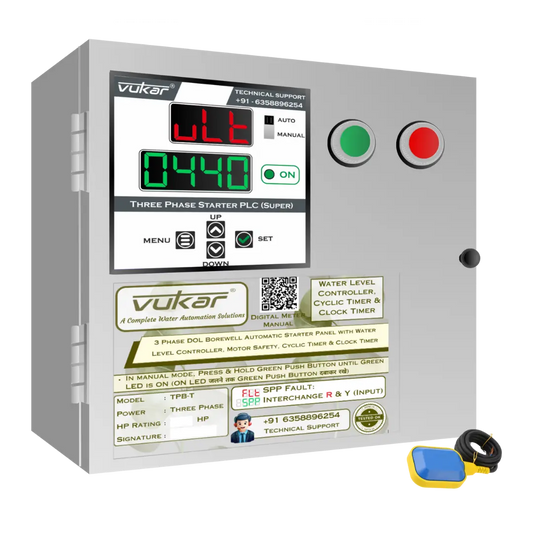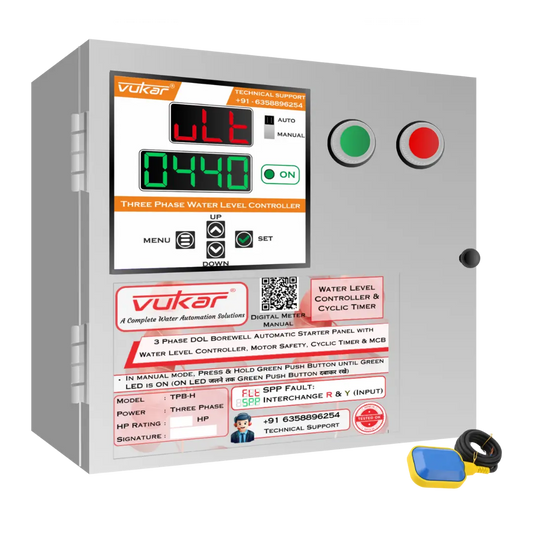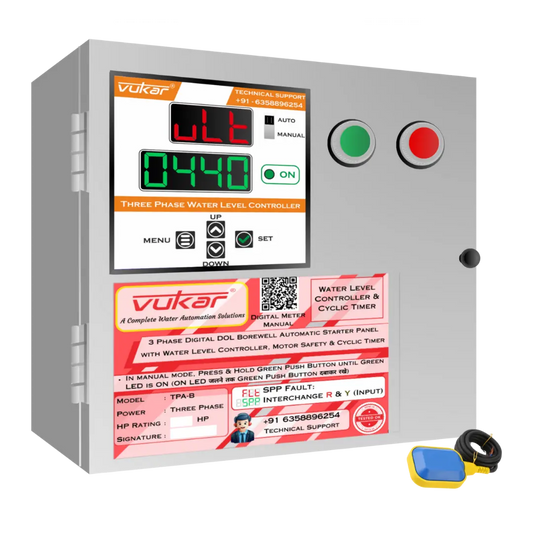

Scheduling a Cattle Farm Trough Supply Pump
VUKARA cattle water pump timer can schedule the refill of a farm storage tank when that tank provides a managed buffer between the source pump and the troughs. It should be selected only after the farm has a practical plan for continuous water delivery, independent level control and a response to a missed refill. The timer decides when the pump may operate; it cannot confirm that water has reached every trough.
This guide concerns utility storage and pumping. It does not set an animal drinking allowance, herd water requirement or water-quality treatment. Those decisions need the farm's appropriate veterinary, husbandry and water-quality advice. Start with the farm's actual delivery records and operating arrangements, then assess what scheduling can reliably support.
Separate the source, reserve and final delivery
Draw the water route in plain language: source, refill pump, storage tank, distribution route and trough. Add any other users sharing the same tank. The storage refill may succeed while a closed valve or blocked trough inlet still prevents local delivery. A motor-running light is therefore not the final service check.
Use the tank as an observable buffer. A responsible person should know its usable operating level, its refill request level and the point at which action is needed. These are site decisions based on the actual tank, supply reliability and response time. They cannot be read from the timer's maximum run setting.
VUKAR's timer and water-level comparison explains why a timed stop and a full-tank stop perform different jobs. For a farm storage refill, the approved arrangement should also address an unavailable source. A level display alone is not proof of automatic stopping capability.

Which conditions should permit a refill?
Write an operating rule before discussing a model: the refill pump may run only when the storage needs water, the source is available, the permitted period is active and the motor conditions allow operation. This is a conceptual control description. It does not specify terminal connections or establish compatibility with a particular existing starter.
Ask the installer to identify the separate source-low and storage-high functions. The source-low stop helps prevent an attempted transfer from an unsuitable source level; the storage-high stop prevents continuing a normal refill after the desired high point. A clock schedule cannot replace either signal where unattended operation depends on them.
KSB's guidance on level measurement discusses the relationship between switching levels, vessel volume, inflow, outflow and start frequency. Its sump example does not define farm storage settings. It does support asking the installer to assess actual water movement and the operating band rather than choosing a timer duration in isolation.
A storage-refill example with declared assumptions
Illustrative worked example: every number in this section is assumed, not measured on a farm. Assume a storage tank has 2,400 litres of usable water above a site-selected action level at 05:00. Suppose the combined recorded-use estimate for this exercise is 200 litres per hour. This is a utility accounting assumption covering the example tank's users, not a cattle drinking recommendation.
At that assumed withdrawal, six hours without refill would remove 1,200 litres. The tank would then contain 1,200 litres above the chosen action level at 11:00. This arithmetic says nothing about whether the action level or the estimate is adequate for a real herd. It simply shows how to make the refill plan visible.
Now assume the refill pump delivers 60 litres per minute to the storage tank while the same 200 litres per hour continues to leave. Convert that withdrawal to about 3.33 litres per minute. The assumed net gain is therefore about 56.67 litres per minute. Replacing 1,200 litres takes about 21.2 effective pumping minutes, rather than exactly 20 minutes.
A 30-minute permitted period would leave some time beyond that calculated requirement, but an unavailable source or power interruption could use it up. Treat this as a test of the planning method. Substitute measured site delivery, observed use and a properly established action level before making an operational decision. The tank capacity calculator helps organise tank dimensions and fill-time inputs.
| Assumed event | Storage accounting | Operator question |
|---|---|---|
| 05:00 reading | 2,400 L above action level | Is the actual level verified? |
| Six hours at 200 L/h | 1,200 L withdrawn | Has actual use changed? |
| Refill at 60 L/min | About 56.67 L/min net gain | Is delivery reaching storage? |
| Missed refill | No assumed replenishment | Who checks and activates contingency? |
Place a check after the scheduled refill
A trough supply pump schedule should include an observation, not only an ON and OFF time. The nominated operator checks that storage gained water and that the distribution route remains functional. Choose a checkpoint while there is still time to investigate and use the site's alternative supply arrangement.
For the illustrative example, a farm might plan a check shortly after the refill window. That timing is a workflow example, not an approved response deadline. The actual deadline must fit the reserve, likely use and time needed to restore service. A check made only after storage is exhausted has little practical value.
Record who performs the check, who covers an absence and how an unresolved problem is escalated. A named backup is more useful than a general instruction to call someone. Confirm that the person can access the necessary equipment and reach the installer or source supplier when needed.

Make the missed-delivery path specific
When the expected level gain is absent, check the visible facts: storage level, source availability, displayed fault, actual pump state and delivery at the tank. Keep electrical diagnosis with the trained installer. Avoid repeatedly resetting a fault merely to make the refill happen.
The farm's contingency may use a verified alternative source, another approved pump arrangement or a managed water delivery. Its suitability, water quality, connection method and capacity need separate site confirmation. Having a spare hose or an untested tank does not by itself establish continuity.
Distinguish an urgent service response from the repair record. First follow the farm's agreed continuity procedure; then preserve the fault message and observations for diagnosis. The current product manual and reset guidance should govern the exact controller's response. Do not bypass source or motor protection to recover a missed window.

Choose the clock function with its limits understood
Use a clock-equipped model when actual time-of-day scheduling is required. A cyclic run/rest device follows intervals; it is not automatically a substitute for a permitted-hours schedule. The timer-types guide explains that difference before a model is chosen.
For DEV-K3, DEV-K4 and DEV-P2, follow the matching DM-Universal-V1 timer instructions. Up to 20 events are provided. Avoid overlaps deliberately; do not depend on an undocumented priority between conflicting events. Enabled days also matter because day selection overrides the schedule.
Changing time or day while the pump runs can affect operation immediately. Review changes with a trained person present. After a power interruption, verify the displayed date, day and time as well as the saved schedule. Do not infer a particular clock-retention period from the presence of a memory setting.
Prove the installation with staff present
Commission the approved arrangement while someone can observe both storage and final delivery. Test a normal refill request, a full-storage stop, source-low response and the end of the allowed period. Ask the installer to demonstrate the documented behaviour after power returns and when a relevant sensor is unavailable.
Check that a missed refill is noticed by the assigned person. If an independent alarm is fitted, prove its complete notification and acknowledgement path. A device specification mentioning a contact is not evidence that a working alarm reaches staff.
- Keep the pump and starter model details with the control settings.
- Record tank level before and after the refill window.
- Check that water arrives at the intended distribution points.
- Keep the continuity procedure and backup contact accessible.
- Review the plan when sources, tank users or staffing change.

Continuity checkpoint: assign an observable result to every refill window. “Pump switched on” is incomplete. “Storage rose, distribution was checked, and the responsible person recorded the result” is a useful operational check. If that result is missing, the continuity procedure must identify the next person and action. Keep this procedure usable during a power cut, including access to contact details and the agreed alternative supply.
Hand over a water-delivery record
Use one simple log for scheduled window, actual refill, level gain, trough-route check, fault and action owner. The next shift should be able to tell whether the tank was replenished and whether any issue remains open. This is the practical evidence that livestock water pump automation is supporting the farm's utility service.
Before buying, send the installer that water-route description, the pump and starter details, and the required level-control functions. Ask for confirmation of a compatible complete arrangement and a demonstrated recovery procedure. Select the timer after the farm's storage continuity plan is clear.