
How an Apartment Society Can Cap Pump Runtime During Water Supply Hours
VUKARAn apartment water pump timer can confine a tank-fed transfer pump to approved operating hours and end its scheduled run at a defined time. Keep the source-sump low-level stop and overhead-tank full stop independent of that time cap. The arrangement here transfers stored water from a ground-level tank to an overhead tank. It does not connect a pump directly to a municipal main or establish what a local water authority permits.
Start with the society's own written operating window and an observation of water actually available in its sump. A published supply announcement and a full source tank are different pieces of information. If the window or arrangement needs approval, obtain the applicable primary document for the property before programming it. All quantities and times in the worked example below are illustrative assumptions.
Write down what the supply window controls
Ask the caretaker to identify three separate things: when water normally enters storage, when the transfer pump may run and when residents need the overhead reserve. Those periods may overlap without being identical. Record who issued the operating instruction, its effective date and who receives changes. A forwarded message without a date is a poor basis for an unattended programme.
This guide assumes the pump draws only from a storage tank. The storage inlet is outside the pump-timing example. Any municipal inlet pump timing question involving a different physical connection needs its own verified design and actual local authority source. Do not infer a city's rules from another society's installation or from the fact that a controller can be programmed.
Inspect the source level at the proposed start and finish times over representative days. Mark days when incoming water is late or absent. Keep these observations separate from the operating authorisation: a good water level cannot extend a prohibited window, and an allowed window cannot create source water.

Build the cap around usable storage
Suppose a society authorises transfer between 06:00 and 07:00. For illustration, assume its written pump event is 06:10 to 06:50, the planned top-up is 4,000 litres and the delivered flow at the overhead tank is 100 litres per minute. These are assumed figures for the example, not measurements from a building or a suggested water allocation per resident.
The nominal transfer takes 4,000 ÷ 100 = 40 minutes. That fits the forty-minute event exactly, leaving no allowance inside the event for reduced delivery. The spare ten minutes at either end belong to this hypothetical operating plan; they do not prove an electrical start delay or a mandatory rule. The supervisor still needs to decide how an incomplete transfer is handled.
| Illustrative event outcome | What it means |
|---|---|
| 100 L/min for 40 minutes | 4,000 L gross delivery |
| 80 L/min for 40 minutes | 3,200 L; 800 L below target |
| Overhead full at 06:35 | Stop early on the full condition |
| Sump low at 06:25 | Stop and report incomplete transfer |
Gross delivery is not necessarily the increase in overhead storage. Residents may draw water during pumping. If the illustrative draw is 20 litres per minute while delivery is 100, the net gain is 80 litres per minute. Forty minutes adds 3,200 litres to storage, even though 4,000 litres passed through the delivery pipe. Measure the quantity relevant to the society's objective.
Use the tank capacity and fill-time calculator to check the calculation. Then review it against available sump stock, overhead free capacity and actual demand during the event. If the required volume will not fit the cap, escalate the capacity or operating-plan issue. Quietly extending a timer turns a visible shortfall into an undocumented operating change.

What each stop is responsible for
The scheduled OFF time sets the end of time permission. The destination-full condition protects against adding water to a tank that has reached its defined limit. Source-low stopping prevents the transfer from continuing when stored source water is unavailable. Motor protection addresses the faults covered by the selected equipment. Have the installer explain these roles as separate functions.
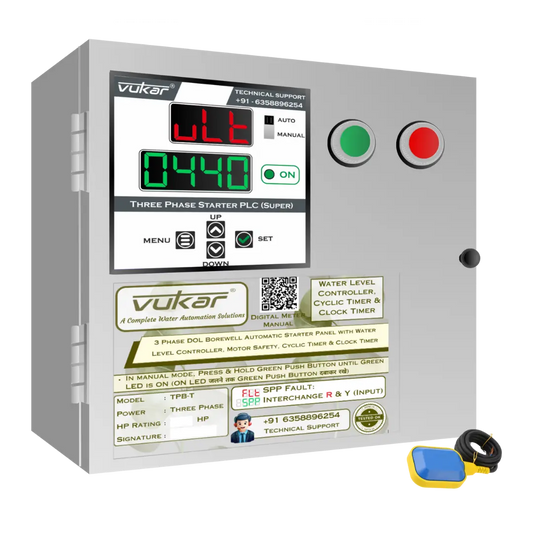
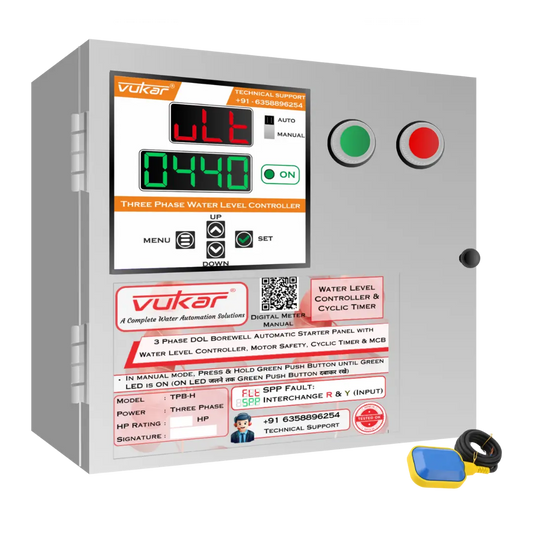
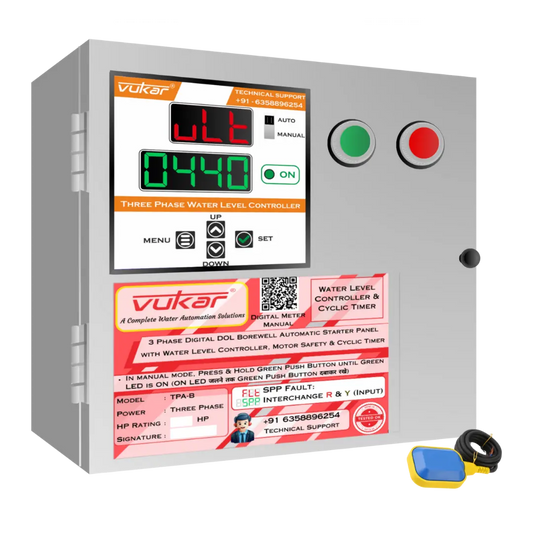
VUKAR's timer guide distinguishes clock timing from level control. A timer does not measure tank fullness. The tank-filling comparison is useful when deciding whether a society mainly needs automatic level replenishment within permitted hours.
Specify the complete functional requirement before choosing a retrofit device. A clock-only auto switch should not be assumed to provide every source and destination input. Confirm the exact starter interface, control supply, level devices and protective stopping with the installer. This article provides no terminal mapping and no instruction to bypass an existing interlock.
The source-low test matters even when the sump is usually full at dawn. KSB's dry-running reference explains the loss of liquid at pump components that normally require it. A supply timetable cannot establish that the pump has water on a particular morning.
Programme a simple building water pump schedule
Prefer the fewest events that meet the authorised plan. For DEV-K3, DEV-K4 and DEV-P2 using DM-Universal-V1 instructions, verify the current manual and equipment revision. The clock function supports up to 20 events, but a society with one morning window does not gain reliability by filling every slot.
Check both the selected days and the start/stop pair. Prevent overlapping events yourself; do not assume the controller detects a conflict or chooses the intended winner. Record a weekend or maintenance-day exception explicitly. The caretaker's written sheet and the saved programme should describe the same operating hours.
If a time or day setting is changed while the pump is running, it can affect operation immediately on the applicable controller. Plan edits under supervision. Keep an authorised version of the old programme so the next shift can distinguish a deliberate change from an accidental key press.

Late supply and power failures need a response owner
Suppose the source tank becomes usable only at 06:35 in the example. Fifteen minutes remain until the scheduled 06:50 stop, so the original forty-minute quantity cannot be assumed. Whether operation may start then depends on the approved control behaviour and conditions at the installation. Record actual start, actual stop and the level remaining; do not label the event complete because its programmed slot has passed.
After a power interruption, verify the displayed clock, day, mode and available source water. Where the applicable run/rest memory setting is used, mem Yes resumes the remaining period and mem No starts that period again. That description does not promise clock retention or define every interaction with clock events. Have the installer demonstrate the configuration the society will actually use.
Assign one person to authorise a supervised recovery transfer when water delivery falls short. It must remain within the permitted arrangement and retain the designed protective stops. Log any temporary change, its reason and when the original schedule was restored. Avoid leaving manual mode active for the following caretaker to discover.
Check performance without rewarding longer running
A useful society pump operating hours record includes planned window, actual motor run, source and destination levels, fault indication and the amount delivered where measured. Compare similar days. Runtime alone does not establish good water delivery: a restriction, leak or changed draw can make the same forty minutes produce a different storage result.
- Observe the receiving tank during the first complete scheduled event.
- Ask the installer to test source-low and destination-full stops safely.
- Confirm the scheduled stop with usable water still in the source.
- Test the agreed outage response under supervised conditions.
For pump or pipework maintenance, follow the site's electrical isolation procedure. A timer waiting for its next event can restart automatically. Record test outcomes in the handover book, including any failed condition that keeps unattended operation on hold.
Agree how the society defines an incomplete transfer before the first run. A log entry can say that the overhead reserve was below its agreed handover level, even when the event ended correctly on time. This prevents a caretaker being encouraged to extend operation merely to make a runtime column look normal. Compare the shortfall with source stock and resident draw, then have the responsible person decide the next permitted action. Keep that decision alongside the original programme, so temporary recovery instructions do not become a new routine by accident.

A caretaker handover that survives a shift change
Place the approved time window, tank identities and responsible contact beside the control log. Add the actual source-level threshold and full-stop test details from commissioning, without copying another building's numbers. Review the programme after water-window changes, plumbing work or persistent underfilling. At the next handover, ask the incoming caretaker to read back the saved day, start and stop times and identify who handles a missed transfer before residents need the reserve.