
Openwell Submersible Pump Starter Panel Supplier in Dholka
Mohit Vekaria
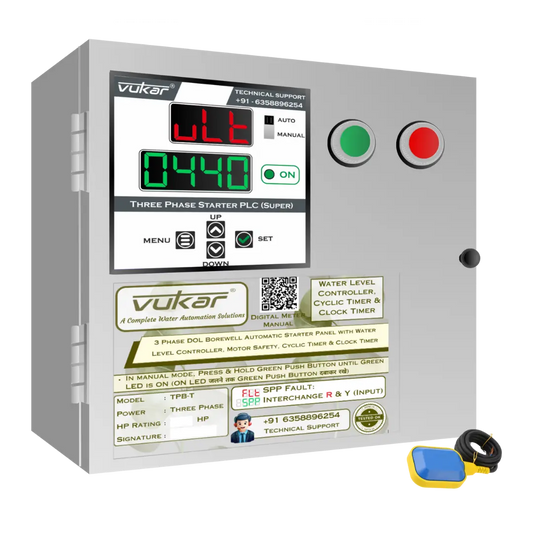
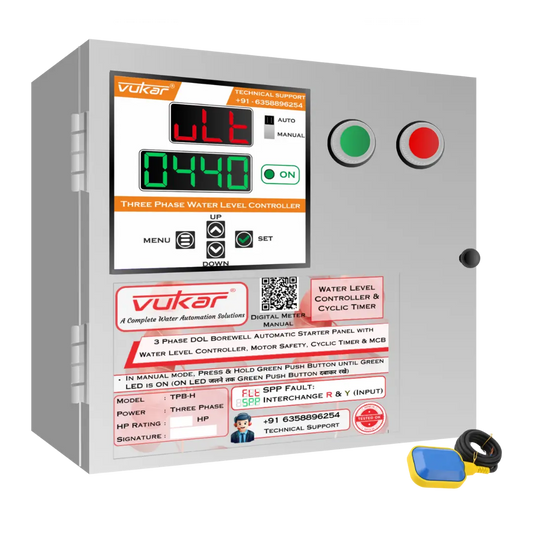
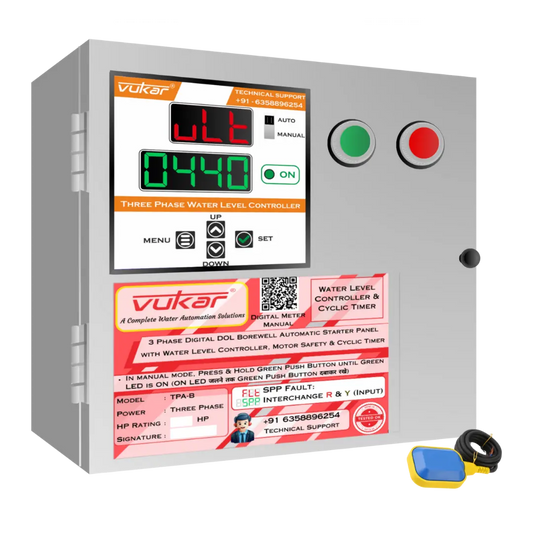
If you are looking for an openwell submersible pump starter panel supplier in Dholka, choose VUKAR OPM-V when someone is there to read the tank status and decide when to stop the well pump. It suits compatible single-phase openwell pumps from 0.5 to 3 HP. If the site needs the pump to stop automatically when the tank fills, choose a starter with water-level control. Put that requirement on the quote before you discuss timers.
Which pipe filled the tank?
The Dholka municipal water-services page records town tubewells and work on a Narmada-based supply scheme that included sumps and overhead tanks. These are records of the town system. On a property that has a separate well and a piped inlet, trace both lines to find out whether they feed the same tank.
The Central Ground Water Board’s Dholka taluka study maps more than one water-bearing layer and presents separate pre- and post-monsoon maps for the shallow layer. Give the supplier the type of well and the actual pump plate. A tank status light describes the receiving tank. It cannot tell the caretaker how much water is left in the well.

A full tank can hide what the well pump did
Suppose the tank has room for 400 litres at the start of a watched test. The well pump delivers 25 litres a minute and a piped inlet delivers 15 litres a minute. With both inputs steady and no water drawn from the tank, the gap closes in 10 minutes. At that point the well pump has delivered only 250 litres. With the well pump alone, the same gap would take 16 minutes. The example shows why the caretaker should record which inlet was active before treating a quick fill as proof of good pump delivery.
During handover, ask the operator to make two short notes: whether the well pump was running, and whether water was arriving through the second inlet. Keep them beside the time and the actual tank reading. If the status shows full and the pump keeps running, stop it from the normal control and have the electrician explain the chosen mode before anyone relies on it.
Water level indicator or automatic level control
| What you need | What to ask for |
|---|---|
| A caretaker reads the panel and stops the pump | OPM-V with the correct tank sensor and a watched handover |
| The pump stops by itself when the tank is full | An OPA starter with compatible level control, tested at the actual full level |
| Both inlets can fill the same tank | A separate plan for the second inlet and a clear handover for both |
The VUKAR openwell starter comparison shows how the models differ. OPM-V has a tank status indicator and cyclic timing. A cyclic timer repeats run and rest intervals. Its timer cannot change those intervals based on the tank status. An automatic OPA starter can switch the well pump using its connected sensor, but that alone leaves a separate inlet under its own controls.

Put the tank name on the supplier enquiry
Send a photo of the pump plate, the motor phase and HP, the source name and a sketch of the receiving tank. Name the tank in plain words, such as the roof tank above the store. Ask the supplier to list the exact OPM-V variant, the supplied float, any extra sensor cable and installation separately. Agree where the caretaker will read the display during a normal shift and who will stop the pump if the tank reaches its full mark.
Keep the first filled-in handover sheet by the panel. Include the tank name and both inlet names. On the next shift the caretaker can see which inlet was active, which motor actually ran and which reading came from the float. That record gives the electrician something useful if the reported fill time changes.