Start Capacitor vs Run Capacitor in a Water Pump: What Is the Difference?
Mohit VekariaShare
A start capacitor helps a suitable single-phase motor start and is then switched out of its circuit. A run capacitor stays in its intended circuit during normal operation. Choose the specified type and rating for the exact motor; the two are not interchangeable replacements.
Your pump may use one type or both. Check the motor and control-box documents before buying a part. The HP rating alone does not identify the right capacitor.
Compare the job each capacitor does
| Point | Start capacitor | Run capacitor |
|---|---|---|
| When it works | During the starting period. | During normal running, in motors designed for it. |
| Duty | Intermittent duty. | Continuous duty. |
| What removes it? | The motor's specified starting switch or relay. | It normally remains connected in its intended circuit. |
| Replacement basis | Motor specification, capacitance, voltage and starting duty. | Motor specification, capacitance, voltage and continuous duty. |
Bodine Electric's motor handbook describes motor designs with a starting capacitor and designs that use an additional continuous-duty capacitor. This is why one pump's arrangement should not be assumed to fit another.
What does the microfarad value mean?
The value marked µF, also written MFD on some parts, is capacitance. It is a specific electrical value chosen for the motor circuit. More microfarads do not mean a better replacement.
Use the manufacturer's stated value or range and its tolerance. Do not choose a capacitor from a chart that lists only “1 HP” or “2 HP” without identifying the motor design.
The voltage marking matters too. It is the capacitor's AC working-voltage rating, not a claim about pump power. Match the specified type and rating; have the supplier confirm any alternative. A physically similar case does not prove electrical suitability.
Why can a new start capacitor fail again?
A start capacitor is not intended to remain energised continuously. If the switching device fails to remove it at the proper time, replacing the capacitor alone may not solve the problem.
Repeated failed starts also call for a wider check. The installer should investigate the starting device, supply conditions and mechanical load. Ask what caused the failure, rather than treating every damaged capacitor as ordinary wear.
HYDRA's motor-start capacitor guidance explains why starting duty and the time spent in circuit are part of capacitor selection.
Can you tell the type from the case?
Case shape and material can offer a clue, but use the label and part specification. Parts may have been replaced before, so even the installed capacitor is not always a reliable guide.
Take the motor model, control-box model and the old part's label to the supplier. If the old label cannot be read, find the approved part from the motor documents. Do not estimate the value from the case size.
Leave testing and replacement to a qualified person
Switching off the motor does not guarantee a capacitor is safe to touch. Stored charge must be dealt with using an appropriate procedure. Do not bridge its terminals with a screwdriver.
An electrician should isolate the equipment, make it safe, test the part and confirm the wiring before fitting a replacement. If a motor hums without turning, keep it off until the cause is found.
What to check when buying a starter panel
Ask whether the selected panel includes the starting components your motor requires, and confirm their specifications. A separate control device and a complete motor starter may contain different parts.
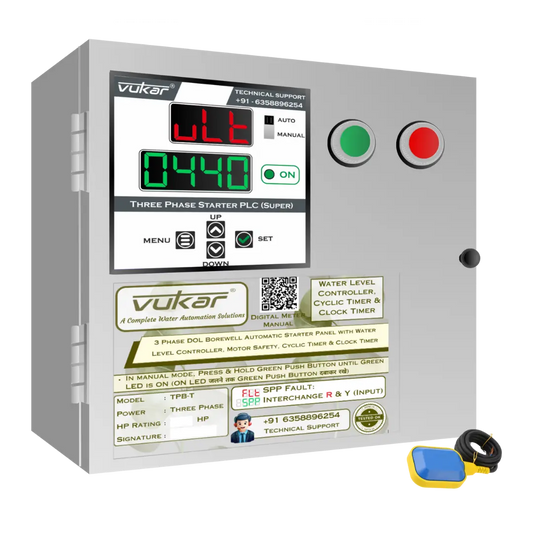
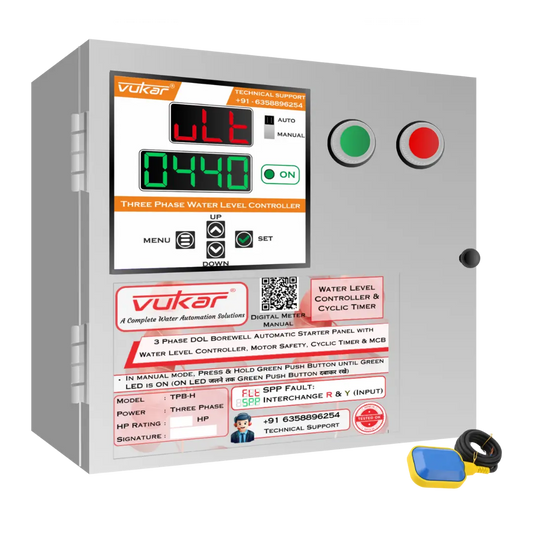
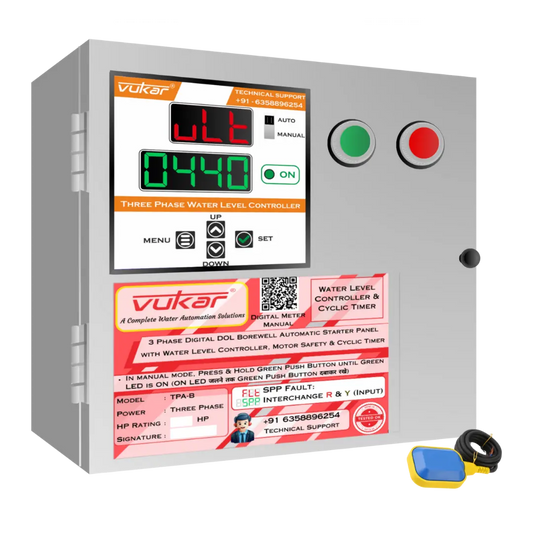
For an existing VUKAR installation, use the model-specific manuals and connection diagrams. Keep a record of any approved replacement so the next service visit does not begin with another guess.