
Earth-Leakage Relay vs RCD for a Pump Panel
Mohit VekariaAn earth leakage relay for pump panel protection usually measures residual current through an integral or separate sensor and acts through another device that disconnects power. A suitable RCCB or RCBO combines residual sensing and disconnection in a breaker. The choice for your pump depends on the supply, the required protection, and the way the panel will disconnect power. Start by asking what opens the circuit on a leakage fault, and whether the complete assembly is specified for that job.
Read the name of the device and its actual job
RCD means residual current device. It describes a class of protection. In everyday quotations it often means an RCCB. An RCCB has residual current protection and opens its own poles, but it needs appropriately coordinated overcurrent protection. An RCBO combines residual current and overcurrent protection in one breaker. The IEC publishes separate scope descriptions for RCCBs under IEC 61008-1 and RCBOs under IEC 61009-1. The right choice depends on which product type and ratings apply to the installation.
An earth-leakage relay, often shortened to ELR, can form part of a residual-current protection assembly. Read the model's documentation to find out whether the sensor is built in or supplied separately and what the output does. A trip contact can signal a compatible release or other approved disconnecting equipment. An alarm output alone tells someone that a condition exists. Ask for the part numbers of the equipment that measures, signals and opens the protected circuit. Some sales quotes mention only the relay.
Follow the current measurement at a high level
A residual-current device watches for a difference between the current going to the load and the current returning through the intended live conductors. A core-balance current transformer, or CBCT, can sense the combined current of a protected circuit. If current returns by an unintended path, such as through an insulation fault to earth, the combined reading can change. In a healthy circuit the current going out and returning through the monitored paths should balance. The electrician has to identify the exact monitored circuit and its neutral arrangement.
An ELR may receive a signal from a separate ring sensor and use auxiliary power to operate. Another model may put a toroid inside the case and still offer a trip contact rather than integral disconnection. GIC's earth-leakage relay catalogue lists external CBCT options. GIC's integral ELR manual shows an integrated toroid with a relay contact output. Ask about the sensor and final switching device as separate items even when the sensor is inside the relay.

Compare the parts that perform the trip
| Option | What the quote should identify | What to confirm |
|---|---|---|
| RCCB | Residual current breaker and a coordinated overcurrent device | Poles, residual rating, waveform type and overcurrent coordination |
| RCBO | Combined residual and overcurrent breaker | Breaking capacity, poles and ratings for the protected circuit |
| ELR and sensor with a separate trip path | Relay, compatible sensor, auxiliary supply where needed, and approved breaker release or disconnecting assembly | How the final equipment opens on a fault and how that action is tested |
| Leakage alarm or indication only | Sensor and signalling equipment | Which separate protection provides disconnection |
A useful acceptance check follows the trip all the way to the protected circuit opening. A panel lamp, an audible click or a changed display can confirm that one part responded. Ask the contractor for the documented end-to-end commissioning result for the proposed assembly. With a relay design, also ask what the protective chain does if its auxiliary supply or sensor circuit fails. Have the contractor use the manufacturer's approved test method and the applicable rules for that installation.

Ask about type, coordination and the motor drive
Two devices with the same residual current figure can react to different current waveforms. If the pump uses a variable-frequency drive, ask the designer to check the drive manufacturer's instructions and the selected residual device's waveform type and application. The supply system, drive and filters can affect compatible protection. Ask how the proposed equipment will work with both the upstream protection and the motor's overload and short-circuit protection. Separate the parameters for each device on the drawing and bill of materials.
Do not size a residual trip setting from motor HP. Its residual rating and timing are part of a complete electrical protection design. For an Indian installation ask the licensed contractor to check the relevant standards and current Central Electricity Authority safety regulations for that installation. Record the supply system, protected circuit, required protection purpose and upstream devices before selecting the final model. One setting from a different site gives little information about how your installation must disconnect.

What can a pump starter already provide?
A starter can provide motor switching and motor-specific protection. A listed MCB has an overcurrent role. A phase monitor can supervise the supply. A dry-run function can respond to an operating condition such as low current. Read those responsibilities separately from residual protection. When you review a starter, request a component list and note if the quote includes an RCCB, RCBO or complete relay-and-trip assembly. A general phrase such as motor safety does not identify the residual protection.
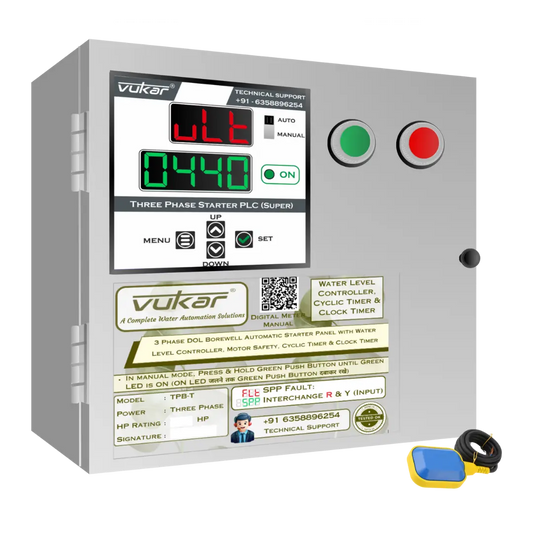
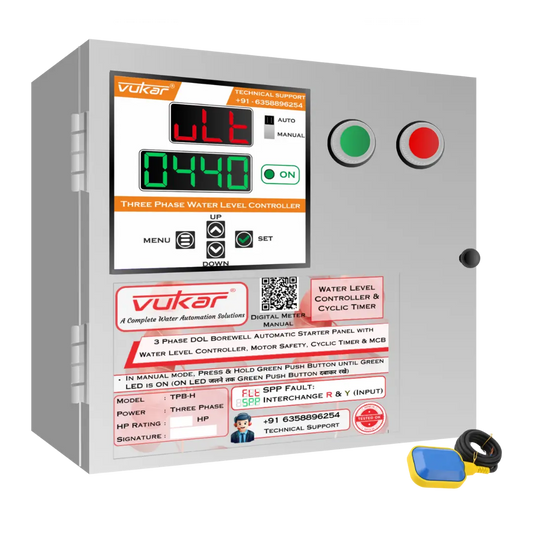
For example, the VUKAR TPM-H product listing describes a three-phase DOL starter with an MCB and automatic controls. Ask the panel builder who supplies the separate leakage protection, where it belongs on the site drawing and what evidence supports the design. Use VUKAR's product manuals to identify the exact starter and its functions before you compare pump panels. The chosen panel and the site's residual protection need to fit one design.
Compare a home pump and a shared farm panel
Suppose one home circuit serves a single-phase pump. A contractor may propose an appropriately selected combined breaker, or an RCCB with separate overcurrent protection. In either case, ask them to identify the circuit and record which device opens it, what protection it provides and how the upstream devices are coordinated. Keep the timer and pump starter controls separate on the list so their function is easy to trace. A neat single-device quote is valuable only if the ratings and installation conditions suit the circuit.
A farm panel may serve a larger three-phase pump with an existing breaker and specified trip release. A compatible relay and separate sensor may fit the design where the protection requirements and documented assembly support that choice. Ask who will supply the compatible components and validate the full trip path together. If there are multiple pumps, ask which circuit disconnects for a fault on each branch and what equipment remains energized. An answer that says the main alarm will come on still leaves the disconnection question open.

What to put on the purchase record
Write down the pump nameplate details, the supply and whether there is an electronic drive. Ask the contractor for the residual protection purpose, exact model and rating, the means of disconnection, overcurrent coordination, and the test and handover procedure. Record whether any separate sensor, auxiliary supply, release or enclosure work must be supplied by someone else. Ask them to mark who checks the upstream devices and to confirm the design follows the current rules for the site.
Use the manufacturer's separate-toroid relay instructions when a design calls for that equipment. A model-specific manual helps define part compatibility and test boundaries. Keep the approved drawing and the commissioning record with the pump panel for future service. If the installer replaces a component later, use that record to check that the new part still meets the same protection and disconnection requirements.
Check what the operator can tell after a trip
At handover, ask the contractor to show which indication belongs to earth leakage and which belongs to the motor protection. If a single panel has separate alarms, label the functions with the words used in the manuals. The operator should be able to report the indication and the pump state without opening the enclosure. Give the site maintenance team a contact and a safe escalation procedure for a suspected insulation fault. The trip record can help the technician decide whether to inspect the pump circuit, the protection assembly or another branch. It also preserves the system boundary the installer originally agreed to protect.
If the panel shares an incoming supply with other loads, agree the extent of the protected circuit before asking for a price. A branch device and an incoming device can have quite different jobs. Give the contractor an up-to-date equipment schedule rather than relying on a panel label installed before any extensions. Confirm that the same drawing identifies the pump circuit and the disconnection point so a later buyer can compare quotes for the same scope.