Cyclic Timer for Ventilation Fans: When TPM-A Fits
Mohit VekariaShare
If you switch a ventilation fan ON and OFF by hand, a cyclic timer can repeat that routine for you. TPM-A provides minute-based ON/OFF settings in a three-phase direct-on-line (DOL) starter panel. Its published specifications describe pump applications, so fan use needs a separate compatibility check. The timer sets when the fan runs; the ventilation design determines whether that cycle provides enough air.
Why manual switching becomes difficult
The starting point is an application described by VUKAR: an operator uses an MCB to switch an industrial or poultry-house fan by hand. The aim is to repeat an ON/OFF cycle without someone returning to the switch every time.
First check what the fan is meant to do. A circulation fan moves air around the space. An exhaust fan removes air and needs a path for replacement air. That difference matters when deciding whether the fan can stop for part of a cycle.
An MCB still has a protection role
An MCB is not simply an ON/OFF switch. A correctly selected MCB provides overload and short-circuit protection within its ratings. It does not create a timed cycle, and it does not replace every motor-specific protection function. A timer-controlled starter still needs properly coordinated circuit protection. [2]
What changes with each control method?
| Approach | When it fits | Main constraint |
|---|---|---|
| Manual switching | An operator intentionally controls each run | No automatic repeat cycle |
| Cyclic timer + existing starter | The starter and motor protection are already suitable | Verify the timer interface and switching duty |
| TPM-A complete panel | A compatible three-phase DOL fan needs timed control and starting | Minute-based timing; verify fan-specific settings |
| Environmental controller | Ventilation demand changes with conditions | Needs the appropriate sensors, interlocks and control design |
What TPM-A adds to the control circuit
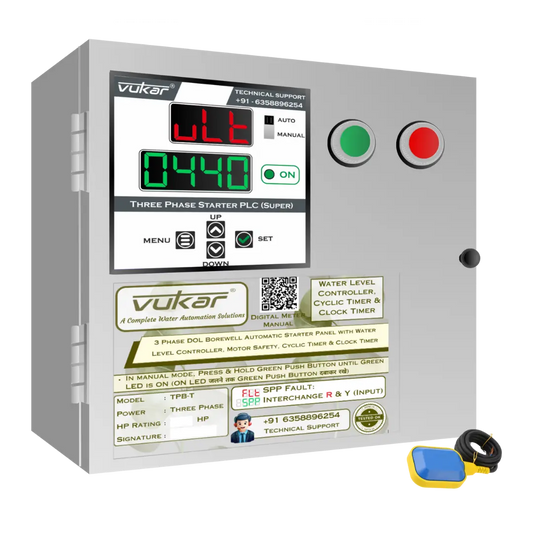
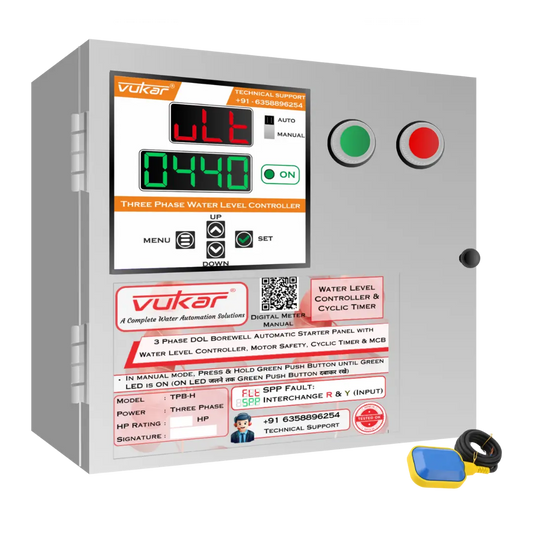
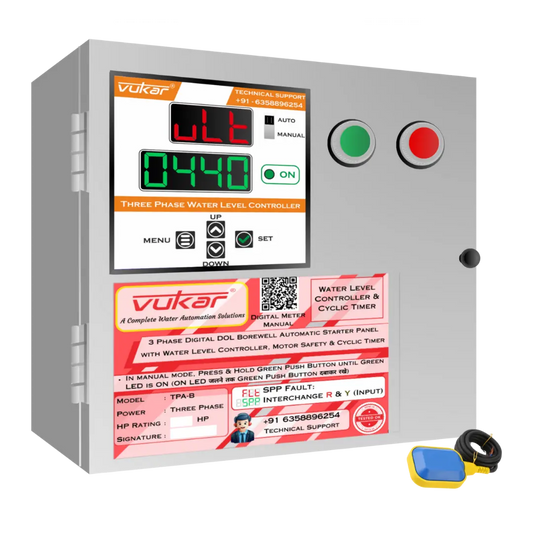
TPM-A combines a cyclic timer, DOL starting and electrical monitoring. The product page lists overload, high/low-voltage and phase-loss functions, phase-sequence detection, a fault display and operating counters. Its pump range is listed up to 10 HP; that figure alone does not confirm suitability for a fan motor. [1]
Once a compatible fan circuit is confirmed, the timer repeats the programmed running and resting periods. The display and fault indications give the operator information to investigate a trip. These functions help with control and diagnosis. They do not prove that airflow is adequate or that electricity use will fall.
Where cyclic operation fits
Industrial ventilation
A timed cycle makes sense only where the ventilation design permits planned OFF periods. Some processes need continuous extraction or an airflow interlock. Others need control that responds to heat or contaminants. A fixed ON/OFF cycle cannot respond to those changes on its own.
Poultry houses
Poultry minimum-ventilation settings depend on the house, fan capacity, air inlets and flock conditions. Some guidance uses adjustments in seconds. TPM-A uses minutes, as confirmed by VUKAR. Check whether its actual settings can represent the required cycle; if finer adjustment is needed, use a controller with suitable resolution. [3]
There is no single ON/OFF setting to copy into every poultry house. Moving air inside the building is also different from replacing stale air with fresh air. TPM-A is not a complete climate controller and should not be described as measuring humidity, ammonia or carbon dioxide.
How the cycle works
In cyclic mode, the fan runs for the programmed ON period, stops for the programmed OFF period and repeats. Before routine use, the installer checks fan direction, airflow and the actual switching sequence over several cycles. Power-return and fault-reset behaviour need separate checks.
Choose the required cycle from the ventilation plan, then compare it with the panel's supported settings and switching duty. The published timing units and the exact adjustment increment are different facts: minute-based operation does not establish the smallest selectable step.
When TPM-A is unsuitable or unnecessary
- A single-phase fan, electronically controlled fan or fan connected to a variable-frequency drive (VFD) needs a compatible control design. Do not assume it can connect directly to TPM-A.
- If a suitable starter and motor protection are already installed, adding a compatible cyclic timer may be enough. Replacing the whole panel is not automatically necessary.
- Where the required cycle cannot be represented by TPM-A’s minute-based settings, or the starting duty or motor ratings do not match, choose another controller or starter arrangement.
- Multiple fans need an engineered circuit and appropriate individual protection; do not select one panel simply by adding their HP ratings.
What to check before setup
Start with the fan nameplate, number of fans, existing starter and required ON/OFF cycle. Have the installer verify motor current, starting duty, permitted starts per hour, timer increments, enclosure conditions and circuit protection. Pump-oriented dry-run/current settings need assessment for the fan load; they do not measure airflow.
Use the wiring guide for the exact panel and check the configured sequence on site. A working timer confirms the switching pattern; the ventilation checks confirm whether that pattern meets the application.
Sources and related reading
[1] VUKAR TPM-A product specifications
[2] Schneider Electric: MCB protection specifications
[3] Cobb: The Importance of Minimum Ventilation and How to Calculate It