Swimming-Pool Pump Timers: Schedule the Pump Without Losing Interlocks
Mohit VekariaShare
A clock-timer starter may suit a swimming-pool pump that is permitted to operate on a defined schedule. Choose the schedule from the pool system's requirements and keep all connected-equipment interlocks working. No fixed number of daily hours is recommended for every pool.
The operating problem
Manual switching can leave a pump off during required circulation hours or running beyond the intended period. A suitable clock control can repeat an established schedule and reduce those routine switching tasks.
It does not determine whether the water has been adequately filtered, disinfected or circulated. Those depend on the pool, equipment and operating plan. Public pools may have requirements that differ from a private pool; check the applicable local rules and manufacturer instructions.
Start with the pump and its existing controller
Identify the actual motor phase, rated current and starting arrangement. Check whether the pump already has built-in scheduling or electronic speed control.
A conventional starter panel must not be treated as a drop-in replacement for a variable-speed or electronically controlled pool pump. If existing controls already meet the operating requirement, additional switching may add no useful function.
Candidate VUKAR panels
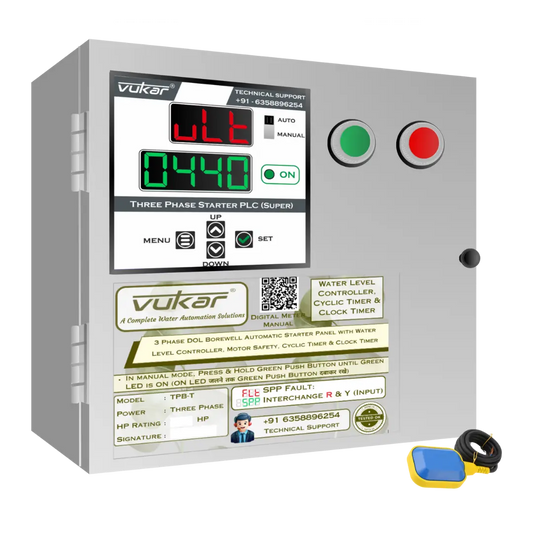
For a compatible single-phase monoblock pump, MOM-T is a clock-family candidate; OPM-T may be relevant to a compatible openwell arrangement. For a compatible three-phase DOL pump, assess TPM-T.
These are conditional application mappings. Exact current range, switching duty and compatibility with the pump manufacturer's control requirements need confirmation. Select a complete starter where one is required, rather than assuming a bare timer can switch any pool motor.
Do not separate the timer from dosing and heating
Chemical feed must not continue under unsafe no-flow conditions. Pool equipment may also need flow confirmation or other permissions before heating or dosing operates.
The clock's ON command does not prove actual flow. Have the system designer retain and verify the required flow interlocks. CDC guidance for public-pool chemical safety is a useful reference for why these controls matter; it is not a substitute for the site's applicable rules.
What should happen after an outage?
Confirm whether pumping should resume inside an active schedule, wait for the next event or require another action. Do not infer pool-system recovery from another application's daily-runtime example.
Test the schedule alongside the existing filtration, dosing and heating controls. Confirm documented protection response and safe maintenance isolation.
The benefit of appropriate timing is a repeatable pump routine. It is unsuitable as a standalone answer to poor water quality, an undersized filtration system or an unverified electronic-pump interface.