Pressure Pump Dry-Run Protection: Keep Demand and Water Availability Separate
Mohit VekariaShare
A pressure pump may receive a demand to run when outlet pressure falls, even if its source has no usable water. The system therefore needs a verified way to stop or inhibit pumping under water-shortage conditions. Pressure control and dry-run protection should be assessed as separate functions.
Why low pressure is not permission by itself
The pressure controller is trying to satisfy demand. It does not necessarily establish that water is available at the pump inlet.
If the supply tank empties or the inlet supply is inadequate, continued operation can expose the pump to dry-running damage. Grundfos identifies bearings and shaft seals among the components at risk in booster-pump dry running. That is a pump risk, not proof that every low-pressure event has the same cause.
Establish what detects water shortage
Supported approaches can include source-tank level, inlet-pressure sensing or the pump/controller's documented detection method. The right choice depends on the installation.
A motor-current-based dry-run function is not a direct water-level measurement. Verify its applicability, settings and response for the actual booster load. Do not replace a required inlet or tank-level interlock with an assumed equivalent.
Where a VUKAR starter may fit
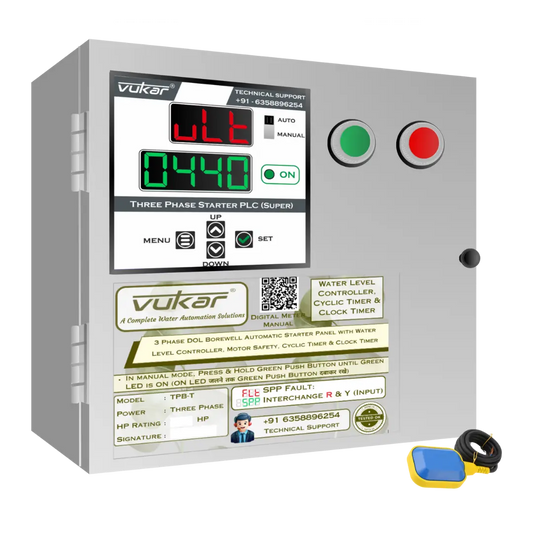
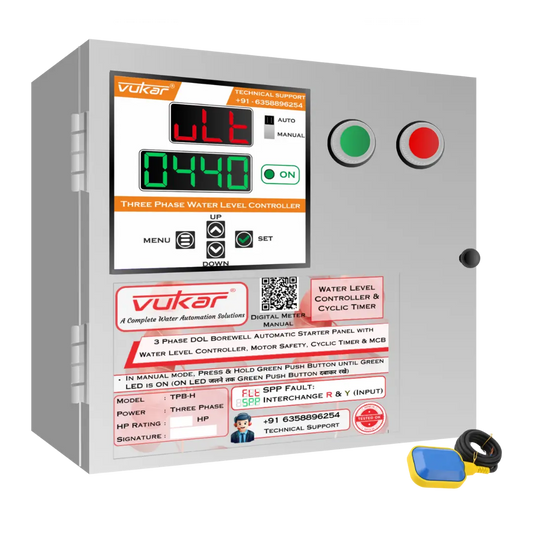
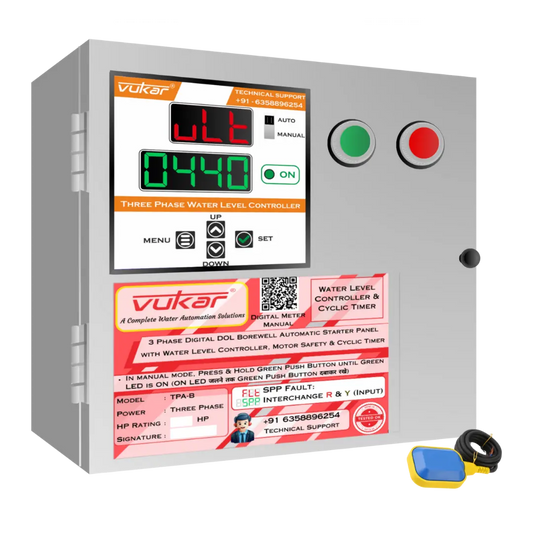
For a new conventional motor installation, prioritize a compatible complete starter panel with the required motor protection. Assess the appropriate single-phase MOM/OPM or three-phase DOL family only after confirming the pressure-demand interface and exact motor/start circuit.
No universal pressure-pump SKU is assigned here. A timer-equipped starter does not automatically accept the existing pressure controller's command or preserve its operating rules.
If the pump has an integrated electronic controller or variable-frequency drive, assess the manufacturer's approved interface. A conventional starter is not a direct replacement for those functions.
Define the stop and the restart
The functional brief should say when a water-shortage condition stops pumping, what prevents further attempts and what evidence permits recovery. Confirm whether recovery is automatic, delayed or manual in the exact arrangement.
A retry timer only waits; it does not prove that water has returned. Repeated pressure demand should not be assumed to override a documented low-water lockout.
What if the pump is already protected?
Some pressure-pump packages include suitable dry-run and water-shortage functions. Confirm how they operate before adding another controller or replacing a sound panel. An unnecessary replacement can complicate the existing sequence.
Have a qualified installer verify motor compatibility, normal pressure-demand control, water-shortage response and documented restart behaviour. Do not defeat the existing interlocks to obtain a start.
The useful benefit is coordinated demand control and a defined no-water response. It does not correct an empty source, leaking pipe, blocked inlet or incorrectly sized pump.