

3 phase submersible motor starter: A Complete Guide to Selection and Use
Mohit VekariaShare
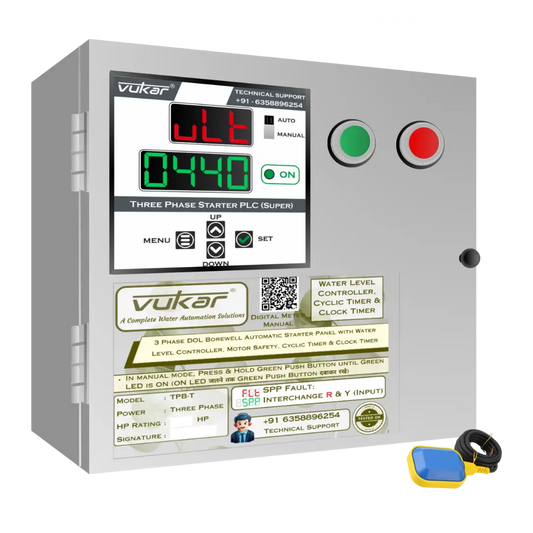
Illustrative example: VUKAR TPM-A three-phase DOL starter panel, not a star-delta starter. Match the exact variant to the motor and supply. The photo does not imply that every function discussed in this general guide is included.
Understanding 3 Phase Submersible Motor Starter Basics
A three-phase submersible motor starter controls the connection between the supply and motor. Its protection functions depend on the components and settings fitted to that model. A starter is not automatically a soft starter, voltage regulator or energy-saving device. Match it to the pump motor and installation rather than selecting from HP alone.
Types of 3 Phase Submersible Starters
A Direct-On-Line (DOL) starter applies full supply voltage at starting; it does not reduce starting current. There is no universal 7.5 HP cutoff for DOL: suitability depends on the motor, load, starter rating and supply conditions. Star-delta starting uses a different circuit and requires a compatible motor winding arrangement, accessible terminals and suitable load. It reduces starting voltage and torque; do not substitute it for DOL solely because the motor has a larger HP rating.
How to Size a 3 Phase Submersible Motor Starter
Give the installer the motor nameplate voltage, frequency, phase, HP/kW and rated current, together with the pump application, cable route and starting frequency. Ask for a panel selection that matches the manufacturer’s motor-duty rating, contactor utilization category, overload adjustment range, control voltage and installation environment. A blanket rule of choosing 125% of motor current is not a complete starter-sizing method. Select and set overload protection according to the motor and protection-device instructions; do not increase it simply to stop nuisance trips.
Protection functions and component checks
Check which overload, phase-loss, voltage and dry-run functions the exact variant includes. Short-circuit protection, earthing and any required additional protective devices must be assessed as part of the whole installation. An overload relay, contactor and circuit breaker have different jobs; one does not automatically replace the others. A trip can reduce the risk associated with a detected condition, but cannot guarantee that a motor will never burn out. Ask for the specific model’s conformity documentation rather than assuming every product has the same certification.
Wiring and Connection of a 3 Phase Submersible Starter
This guide is not a terminal-by-terminal wiring instruction. Have a qualified electrician use the exact panel and motor diagrams, safely isolate and verify that the supply is de-energized before work, and check earthing, cable selection, phase sequence, control supply and protection coordination. Commission the starter with the actual pump. Confirm stop behaviour and any automatic restart after a power interruption or fault. An Auto/Off button is not a substitute for safe electrical isolation.
Applications and optional automation
Three-phase starters are used with suitable pumps in irrigation, building water supply and other pumping installations. The panel alone does not establish the pump’s suitability for chemicals, sewage or a particular water source. Tank-level control, cyclic timers, dry-run detection and remote monitoring are separate model-dependent capabilities. Confirm the sensors and wiring they require. A basic DOL starter does not by itself reduce running energy use; any savings depend on the actual pumping task and reduced unnecessary runtime, not a guaranteed percentage.
Choosing the Right 3 Phase Pump Starter for Your Needs
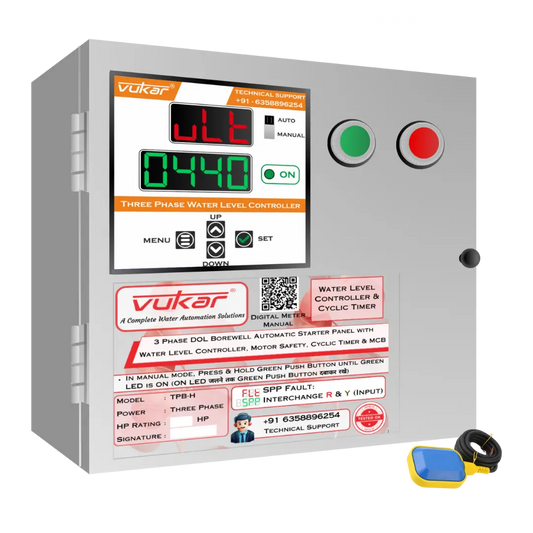
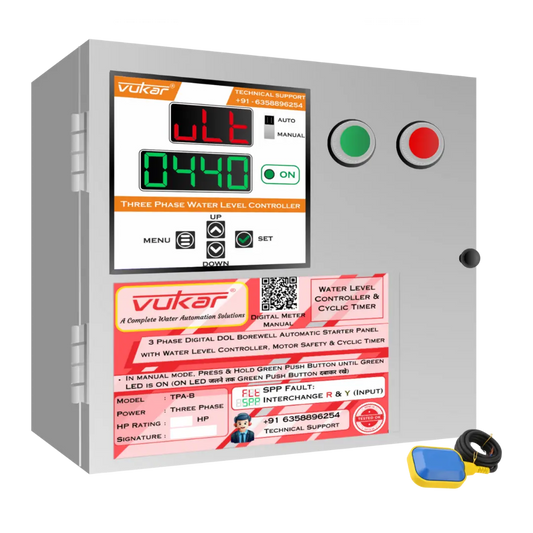
Compare the exact variant’s rated current, protection range, starter type, enclosure, operating modes and support documentation. Check a 7.5 HP motor’s nameplate and supply just as carefully as any other size. Record which functions are included, optional or absent, and verify the settings at commissioning. Use the range and comparison links below as a starting point, then confirm the model-specific specification before ordering.
Maintenance and Troubleshooting Tips
Without opening the panel, record displayed fault codes, unusual operation and the circumstances of a stop. Stop use and obtain qualified help if there is smoke, burning smell, visible damage or repeated tripping. A qualified electrician should perform internal inspection, electrical measurements and protection tests using safe isolation and the manufacturer’s instructions. Do not repeatedly reset a fault, bypass protection or assume that a changed setting has repaired a motor or supply problem.
Conclusion
Choose the starter from verified motor and installation data, not a universal HP limit or current multiplier. Proper selection, commissioning and maintenance matter alongside the documented protection functions. Confirm the exact model and restart behaviour before unattended operation.



2 comments
7,5hp20sth। Pap
I need starter for my 2 HP three phase submersible pump