
Automatic Water Level Controller Supplier in Ahmedabad
Mohit VekariaIf you need an Automatic Water Level Controller Supplier in Ahmedabad, SubmersibleShop.com offers the VUKAR DEV-H4 for a compatible single-phase openwell or monoblock transfer pump. It is an option when a housing society wants to allow pumping during set hours and stop the transfer based on tank levels. A float is a switch that moves with the water. Order around the two tanks and the pump you already have.
Apartment water level controller for a limited inlet
An earlier Ahmedabad Municipal Corporation budget describes timed supply and plans to test continuous supply in selected wards. The practical point is that a society should use its own observed inlet hours. A time printed in a budget cannot tell you when water reaches the building. Start with the approved inlet, the ground-level storage tank and the roof tank. The transfer pump in this example moves stored water between the two tanks.
During a short inlet window, the lower tank might still be filling when the morning pump window opens. A resident can also draw water from the roof tank at the same time. A clock alone cannot see either change. Give the person who looks after the building two tasks: record when the lower tank can supply water and note when the upper tank usually needs a refill. These are separate facts.

How a clock timer with float control helps
A clock timer uses times of day, such as 06:30 to 07:15. A level switch responds to the actual water level. In a two-tank transfer, the society can ask for three rules. Start only when the upper tank calls for water, the lower tank has water and the run window is open. Stop when the roof tank is full, the source tank reaches its low point, or the window ends. Have the installer confirm how these rules work together on the exact model.
Worked example · A 45-minute morning window
Assume the clock opens at 06:30 and closes at 07:15. At 06:30 the lower tank is still low, so a correct setup waits. At 06:40 the source has recovered and the roof tank calls for water, so transfer can begin. If the roof tank fills at 06:55, the pump stops then.
| Condition | Requested result |
|---|---|
| Lower tank low | Hold the pump off |
| Roof tank full | Stop the transfer |
| Time window closed | Keep the pump off |
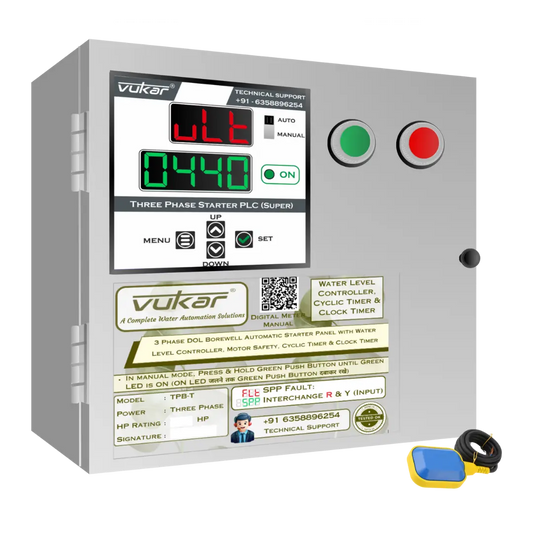
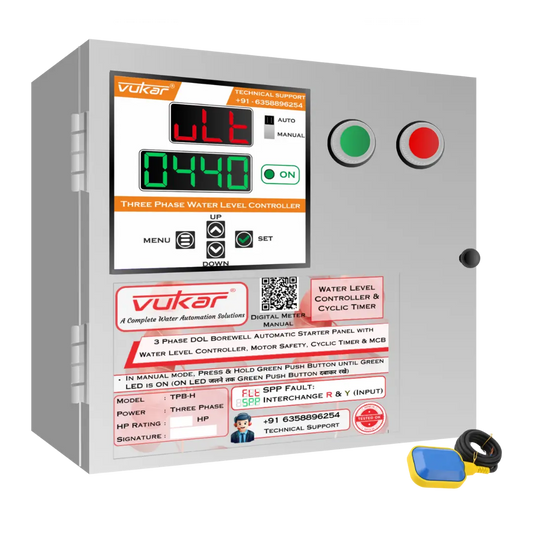
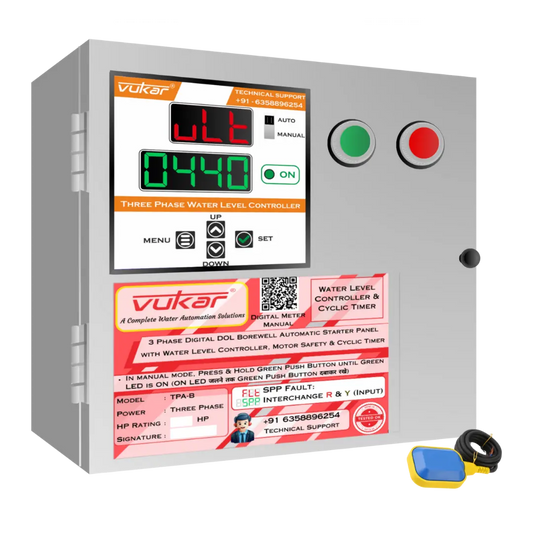
The VUKAR DEV-H4 product listing shows a clock timer, cyclic timer and two cable floats. A cyclic timer repeats an on period and an off period. It serves a different job from a fixed morning window. Decide which timing mode the society needs before the electrician sets it up. If the approved run time is open all day and tank levels alone decide the transfer, compare a simpler level control option.
Sump and overhead tank floats need room to move
Put the source float where it can show low water without rubbing a wall or touching the inlet stream. The receiving float must be able to reach its stop position. Tell the supplier the height between tanks and the route the two cables must take. A long or awkward route can change the installation quote. Agree where the installer can safely reach each float later if the tank is cleaned.
Get a single-phase pump controller quote
Send the pump nameplate, both tank locations, photos of the existing starter and the permitted run hours. A nameplate is the label with the motor's voltage, phase and rated current. Specify who will supply the floats, cable and fitting work. Ask the electrician to test a low source, a full roof tank and the end of the time window. Write down what should happen when power returns before the job is signed off. For handover, ask for one normal fill test as well. The caretaker should be able to point out which light or display shows the current state. Leave a short note with the intended hours and the installer’s number so the next shift can spot a change.
Use the single-phase level controller comparison to choose between float control with and without clock timing. Then send the tank sketch and motor details to VUKAR for the exact model and installation scope.