
Automatic Garden Watering Without a SIM Card
Mohit VekariaYou can set a pump to water the garden without a phone call each time. A local timer can handle the starts and stops. VUKAR's TPM-T is one option for a matching three-phase pump. Its clock mode and daily run-time mode use different rules.
See garden watering control without a SIM card with Vukar Automation. Describe the watering schedule before selecting a timer arrangement.
Start with the garden's needs
Do you switch the pump by hand each morning? Or change its run time each evening? Write down the days and times you need. Then choose a timer that can follow that plan. Garden irrigation means supplying water to plants.
A 30-minute or three-hour run is just an example. It is not a watering rule for all gardens. Choose the time to suit your plants, soil and water system.
Choose the right timer rule
- Clock mode: the pump may run only in the hours you set.
- Cycle mode: the pump runs, rests and repeats for set times.
- Daily run-time mode: the pump aims to complete a set amount of running time that day.
Choose the mode before setting the time. A clock sets when the pump may run. A daily total sets how long it should run. VUKAR confirms that TPM-T can finish the time left after a power cut in daily run-time mode. That rule does not apply to every timer mode.

Compare the choices
|
Control |
Useful when |
What to check |
|---|---|---|
|
Manual starter |
A person can switch it each time |
Someone must be there |
|
Auto switch |
A start after power returns is needed |
It may not set watering hours |
|
SIM control |
You need phone commands |
Signal, features and plan costs |
|
Local pump timer |
You can set the routine at the panel |
Pump fit and the chosen timer mode |
|
Soil or rain control |
Watering must follow soil or weather |
The right sensors and valve control |
Set different morning and evening times
You may need water on some days, not every day. You may also want a short run in the morning and a longer run in the evening. A matching clock panel can follow the selected-day plan.
Write down each day, start time and stop time. Give morning and evening runs their own times. Check which pipe or valve must be ready. The example is a way to plan, not a rule for how much to water.
VUKAR's timer guide covers chosen-day clock use on models that support it. TPM-T lists more than one clock event. Check the day and event settings on the exact model. It must also match the pump's power supply and motor.
What if a clock session is missed?
Suppose watering is set for 6–7 a.m. The power stays off until 8 a.m. In clock mode, that session is skipped. The pump does not make up the lost time outside the allowed hours. It also stops at the set end time.
This is the VUKAR clock-mode rule confirmed by Mohit Vekaria. Test the chosen days, start times and stop times during setup. Check what happens when a run crosses midnight too.
A timer starts and stops the motor. It does not choose garden zones or detect rain by itself. It does not measure water in litres. Make the correct water route ready before an auto start. Keep the needed water-source and motor checks.
Which pump can use TPM-T?
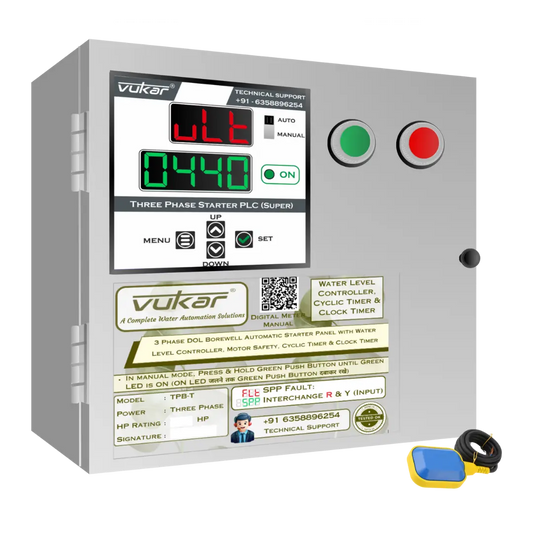
TPM-T is a starter panel for three-phase pumps. A starter is the box that starts, stops and helps protect the motor. This model uses DOL, or direct-on-line, starting. The exact model and settings must match the motor. Check the product guide for its rating and protection features.
A routine set at the panel needs no SIM card. It needs no phone command for each run. Remote commands or alerts need separate features. Check those if you want to control the pump from far away.
The timer sets starts and stops. Motor protection checks the faults it is built to detect. It cannot fix a lack of water, a leak or a broken pump. Keep up the normal pump checks.
Daily run-time mode after a power cut
Now use a 30-minute daily target, not a clock window. The pump runs for ten minutes. The power fails. When good power returns later that day, TPM-T runs the 20 minutes left. It then stops until the next day.
The pump does not start a new 30-minute target. It still needs enough water, good power and no fault that blocks a start. Test a power cut during setup. Ask how the chosen mode handles the change to a new day.
When you need more than a timer
- For a single-phase pump, choose a matching single-phase panel. TPM-T is for three-phase pumps.
- If a working starter already fits the pump, ask if a timer can be added. Keep the motor protection you need.
- If watering must follow soil moisture or rain, use controls with the right sensors.
- If you water several zones, check the valves and their order. A pump timer alone does not choose zones.
- If you need phone commands or alerts, choose a control with those features.
Check it before use
Ask the installer to check the pump label and power supply. Check the panel model, water source, motor settings and timer mode. Test the clock after a power cut. Use the model's own setting guide for its buttons and codes.
Watch a full test run. Check that water reaches the right place. An ON light alone cannot prove that plants got water. Running time does not measure litres.
Related guides
Pump timers: cycle, clock and auto-off
Choose a starter panel for your pump
If TPM-T fits your pump and timing needs, view its product options.