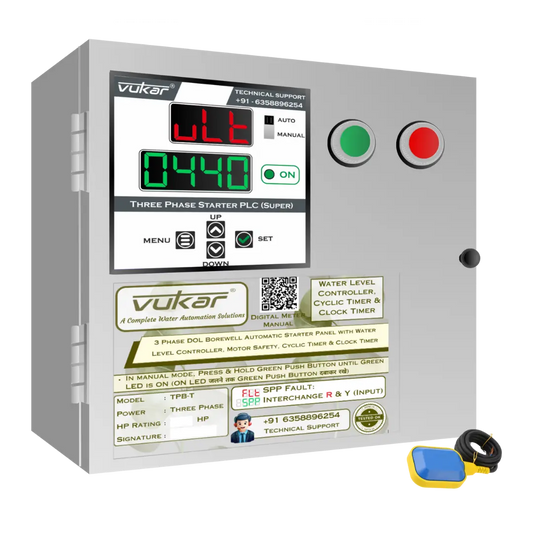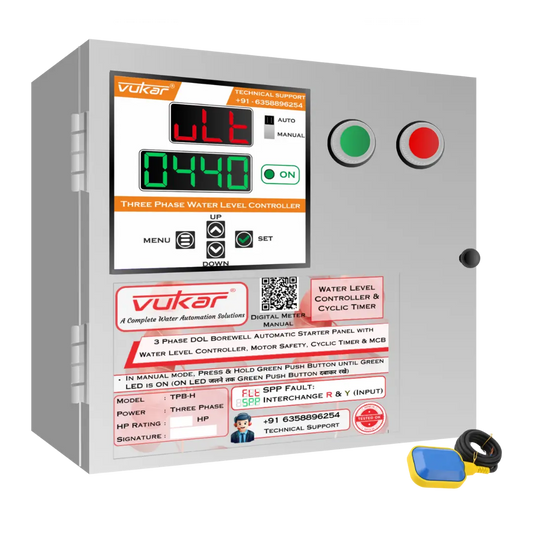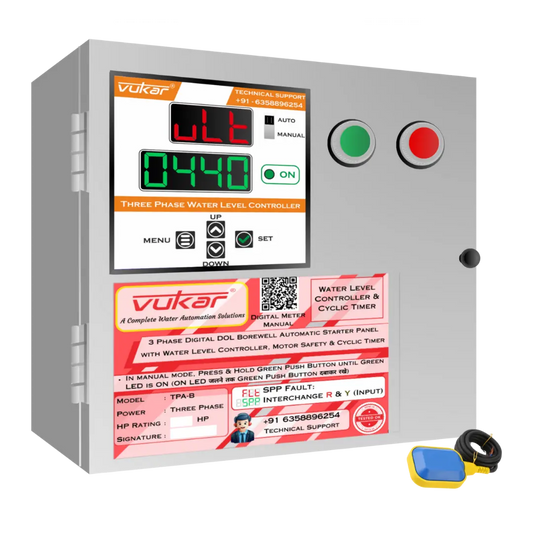

VUKAR BOM-F Borewell Starter Panel: Installation and Auto-Off Timer Settings
Mohit VekariaFor a VUKAR BOM-F borewell starter panel setup, match the panel to your single-phase pump and have a licensed electrical contractor install it using the diagram for your exact unit. The auto-off timer stops a pump run after a set number of minutes. Set the RUN duration for your site, then stay with the pump through a test run to make sure it stops when expected.
BOM-F installation starts with the motor nameplate
Look for the nameplate on the pump motor, or use its paperwork if the motor is already down the borewell. Note the supply phase, rated voltage, horsepower (HP) and rated current in amps. Compare those details with the panel label. VUKAR lists BOM-F for compatible single-phase borewell and openwell pumps in six options from 0.5 HP to 3 HP. The catalogue lists the 3 HP option as heavy duty. The panel and motor still need to match by current and the intended daily use. VUKAR product catalogue
Give the installer the BOM-F model and variant, the motor details, and the wiring diagram supplied with the unit. Ask them to check the motor connections, the capacitor requirements and the protective earth. The protective earth is the safety connection for exposed metal parts. BOM-F comes without a built-in miniature circuit breaker (MCB), so the installer must check the upstream protection and isolation for your circuit.
Have the installer isolate the supply and verify that it is off before opening the enclosure or handling conductors. After installation, ask them to show you the normal start and stop controls and the separate supply isolator. A pump that has stopped by timer can still have a live supply at the panel. Central Electricity Authority safety regulations

Ask the installer to check the mounting position too. You should be able to read the display and reach the normal controls from a dry place. Follow the panel’s installation instructions for its enclosure and mounting conditions. Keep a copy of the matching wiring diagram where the next service technician can find it.
BOM-F auto-off timer settings
RUN is the run-duration setting, measured in minutes. Confirm the timer menu, the operating mode that enables timed stop, and the save sequence using the instructions for your panel revision. Read the saved RUN value back before the test. If the label, screen or guide differs, send VUKAR the panel label and a photo of the display so support can identify the correct procedure. VUKAR manuals and parameter reference

Choose a run time using the water level and pump flow
Start by observing a normal fill while you can watch the tank and stop the pump at its usual control. Record the starting water level and the time it takes to reach your chosen stop level. Keep room below the overflow. Also check how long the pump can run while the borewell supplies water steadily, and stay within the pump maker’s operating limits. Use those observations to pick a first setting for a watched run.
Think about what changes from one run to the next. A tank that already has water has less space to fill. A change in borewell yield, delivery height or an open outlet can affect how fast the level rises. If water is drawn while you measure, the same duration could bring the level higher when that draw stops. Check the run time under the conditions in which you actually use the pump. Where the tank must stop filling at a fixed level, choose a compatible water-level controller with a level sensor. Tank filling and level control guide
Write down the settings at handover
Keep the setup record near the panel or with the pump paperwork. Write the RUN value with its unit and the confirmed mode name exactly as shown on the display. Record the starting level and the observed stop time beside the saved setting. If a service visit changes the motor, the pipework or the water source, use that record to check which settings and test results need to be revisited.
Keep the protection settings with the installer
BOM-F parameter settings also cover overload, dry run and high or low voltage. Overload protection responds to excessive motor current. Dry-run protection can respond when current falls below its set limit, which may happen when water supply is lost. The installer sets and checks these protections for the actual motor and installation. Ask them to write down the approved values at handover so a later service visit starts from the settings that were tested. BOM-F features and installation information
How to use BOM-F after installation
- Get ready for a watched run. Check that the water source can supply the pump and the receiving tank has space. Close the starter enclosure and confirm the saved RUN value and approved operating mode.
- Start the pump as shown by the installer. Note when the motor begins running. Use the motor-on indication, the display and normal water delivery to check the run from a safe place. Watch the tank during the test.
- Check the timed stop. At the end of the set duration, confirm the motor has stopped. If it keeps running, use the normal stop control from a dry, safe location and have the installer verify the mode and saved value before further use.
- Record what worked. Keep the panel variant, motor details, confirmed mode, saved run time and observed stop time together. Ask the installer to document what the panel does after power returns or a fault clears.

If a power cut or fault interrupts the test, record the time and display before starting another run. A clean test starts under normal conditions and ends at the set duration. The front display and hardware views are also shown in the BOM-F product video.
What to check if BOM-F stops early
A timed stop normally follows the saved run duration. If the pump stops sooner, first write down how long it ran and what the display showed. FOL indicates overload, FDR indicates dry run, HIU indicates high voltage, and LOU indicates low voltage. The code tells you which protection condition was detected. Record it before asking the installer to check the cause. VUKAR fault-code guide
If the pump stops at the expected time but the tank level is lower than expected, compare the starting level and water delivery with your first test. Check whether someone was drawing water or whether flow slowed during the run. If a fault recurs or the pump delivers little water, have the cause checked before extending the run time.
Common BOM-F questions
Will BOM-F stop when the tank is full?
Its auto-off timer stops by elapsed time. Full-tank stopping requires a controller that can read the water level. A timed run works best when the starting level and flow are predictable, and the owner can check the result.
Can I use the timer as a daily start schedule?
The BOM-F timed stop limits the duration of a run. A daily start at a fixed hour needs clock scheduling. For any behavior after an outage or fault, follow the instructions for the installed unit. VUKAR timer types guide
What should I keep for the next service visit?
Keep the panel label photo, pump nameplate details, wiring sheet, approved mode and recorded settings. Add the date and observed result of the first timed-stop test. If a fault occurs later, these details give the technician a baseline to check.