
When a Tank Needs a Continuous Level Sensor
VUKARA continuous water level sensor is useful when you need to know what happens between empty and full: how much reserve remains, how the level changes or when someone should arrange another supply. If the only required action is to start a pump at a low point and stop it at a high point, threshold switches may be sufficient. Decide who will use intermediate readings before paying for them. A percentage display becomes useful when it answers a real operating question and the complete system handles missing or invalid information clearly.
Start with the decision a reading must support
Write down one question that a low and high switch cannot answer. Perhaps a caretaker needs to know whether the remaining water will cover a planned shutdown. A facility manager may want records of overnight level changes. Another site may need a reading at a desk because checking a remote tank is inconvenient. These are reasons to consider a continuous measurement system.
Be specific about the next action. If a low reserve should prompt a telephone call, identify who receives the information and who makes the call. If a trend should prompt an inspection, decide who checks the record. A sensor cannot provide an operating routine on its own. The receiving equipment, useful presentation and ownership of the response belong in the same plan.
Do not buy a detailed reading simply because it looks more advanced. For an unattended tank, a basic full indication might already answer the household's question. A continuously changing number creates more information, but it also needs an agreed meaning. Ask what decision will improve when the number changes from one value to another.
Point level and continuous level answer different questions
A point-level device reports a condition at a particular position. A float switch used for a low or high threshold is one familiar example. A continuous instrument provides a changing measurement across its specified operating range. Several point indicators can show useful bands, but that does not make them equivalent to a continuous transmitter.
An instrument can combine both functions. The ifm KQ10 manufacturer overview describes a particular capacitive sensor that provides switching points and a percentage value through IO-Link across its documented measuring length. This is an example of combined functions, not a recommendation for every household tank or a specification for other sensors.
| Required decision | Point-level arrangement | Continuous measurement |
|---|---|---|
| Start filling at a chosen low level | Can provide a threshold signal | Can provide a value for suitable control equipment |
| Stop filling at a chosen high level | Can provide a threshold signal | Requires suitable configured receiving equipment |
| See intermediate level | Shows only the fitted points or bands | Provides a changing value within its range |
| Review level over time | Needs separate recording of states | Needs a suitable recorder or data system |
Keep those last conditions in the quotation. A transmitter is not automatically a recorder. A low and high switch arrangement is not automatically a complete motor-control panel either. Compare complete systems that deliver the same required action.

A percentage needs an agreed reference
Before discussing accuracy, ask what zero and one hundred percent mean. The configured measuring range may represent the usable operating band rather than the tank's entire physical depth. Water can remain below the chosen empty reference. Space can remain above the chosen full reference. A percentage is only understandable when those references are recorded.
Level percentage and stored water volume also differ. In a tank with a constant horizontal cross-section, equal changes in height correspond to equal changes in volume. A tank whose shape changes with height needs a suitable level-to-volume relationship. Do not label a height percentage as litres without the right tank dimensions and conversion method.
For an ordinary building, a clearly described usable-level display may be enough. Ask the installer to write down the reference points and the displayed units. If someone later changes the sensor position or replaces the tank, review that configuration. A familiar looking number should not hide a changed physical reference.

Choose the sensing method for the tank
Continuous measurement can be achieved by different technologies, including radar, ultrasonic and pressure-based instruments. Each exact product has installation and environmental requirements. Ask about tank material, water conditions, mounting space and access before deciding which technology suits the job. The same display format does not make the instruments interchangeable.
For example, VEGA's VEGAPULS C 11 page describes a wired radar instrument for non-contact continuous level measurement with a 4–20 mA output. That output is a detail of the named product. It does not establish that a household controller accepts it or that a display is included.
A sensor also needs a suitable location. Show the supplier the inlet stream, nearby walls and internal obstacles. Ask how the proposed installation covers the full useful range. If condensation, foam or changing water conditions occur, describe them in the enquiry. Request a model-specific response rather than relying on a generic technology description.
Keep simple filling control in the comparison
A tank that needs only two operating thresholds may be well served by a wired float arrangement. This remains worth comparing even when you initially search for a continuous water level sensor. Obtain a separate quotation against the same filling requirement, including installation and the intended pump connection.
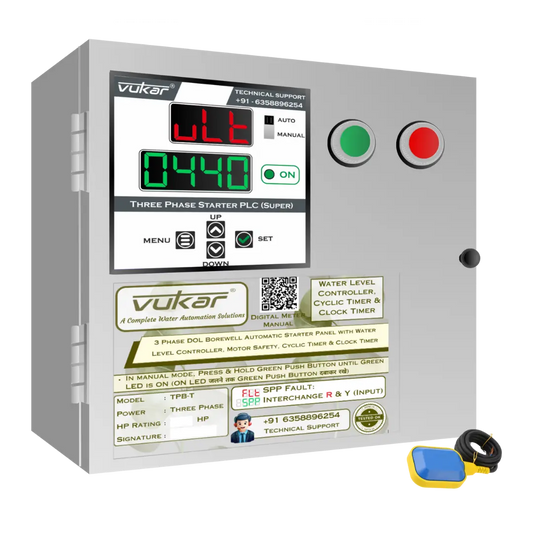
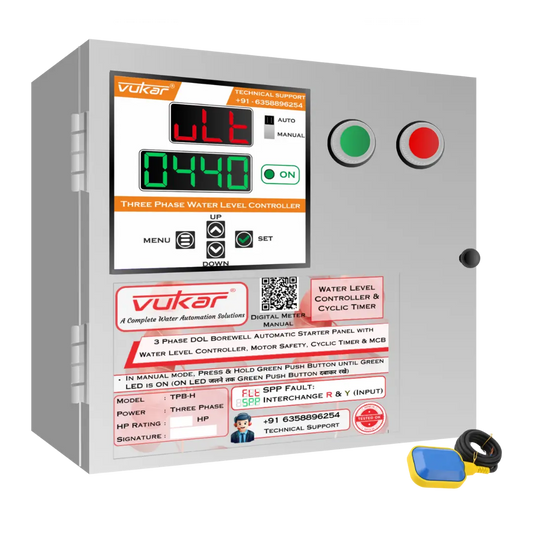
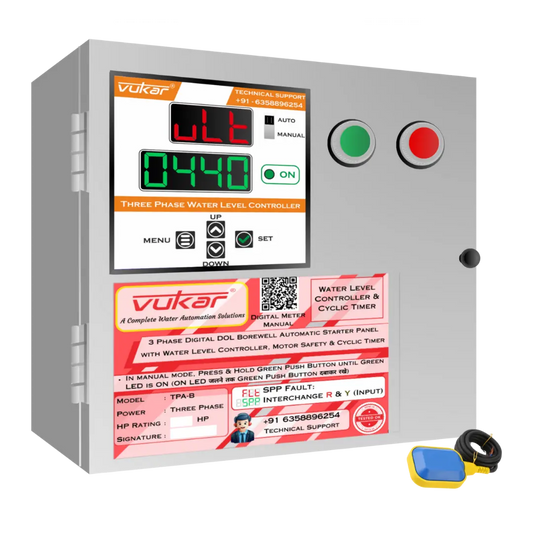
The VUKAR family below is a wired threshold-control option for that narrower need. Choose the model by supply phase, pump type and float arrangement. It should not be presented as a continuous transmitter, an analogue input module or a trend recorder. Do not connect a proposed transmitter to float terminals without explicit approved compatibility.
Use the VUKAR product manual page to locate supported installation documents for a selected model. Ask a qualified installer to check the complete arrangement. More detailed measurement can be added only through equipment designed and documented to use it; a percentage display alone does not justify changing a working control circuit.

Plan how missing information will appear
Ask what the operator sees when a sensor loses power, a signal is invalid or communication is interrupted. An old reading can look reassuring if its age is hidden. Request an explanation of how the selected display or software identifies stale data, and what the operator is expected to do next. Treat unanswered behaviour as a purchasing question.
If the value affects automatic filling, specify the required response separately and have the supplier confirm a supported design. Do not assume that losing a value always stops a pump or that the previous state is always retained. The outcome depends on the actual equipment and configuration. Record it before the installation is relied upon.
A separate high-level protection arrangement may be appropriate where the consequence of overfilling warrants it. Ask the designer to assess that need and explain its independence from the measurement path. A second number on the same screen does not by itself prove that there is a separate protective function.
Decide whether a trend will be interpretable
A useful history needs timestamps and a known sampling arrangement. Ask what is stored, how long it is retained and how it can be retrieved. If several people use the record, agree who checks it and how a suspected problem is escalated. Avoid buying a logging feature without someone responsible for reading the results.
A falling level alone does not prove a leak. Water use, transfer operations and filling schedules can also change the tank. Compare the record with known activity before arranging repairs. Write observations alongside the level history so a future reviewer can distinguish normal use from an unexplained change.
Start with a simple observation question, such as whether the tank falls during an agreed idle period. Establish the conditions with the site's operator. The record can then guide an inspection; it should not be presented as a certified water audit or an independently measured flow total without suitable equipment and evidence.
Specify a useful handover
Before acceptance, have the installer show the reading at known, safely accessible water levels using the manufacturer's procedure. Confirm units and reference points, then demonstrate the agreed missing-value indication and the response of any connected control equipment through supported methods. Record checks that cannot yet be completed and assign a person to finish them.
Keep the model identity, configuration record and relevant manual together. Give the caretaker a short instruction explaining what normal information looks like and when to seek help. Your next step is to send suppliers one written requirement covering the decision, usable measuring range, display location and any recording or pump-control function. Ask them to price the complete arrangement against a separate threshold-only option.