
Smart Plug vs Water Level Controller for a Water Pump
VUKARA smart plug for water pump use can provide remote on/off commands or timing, but it is suitable only when the exact plug is approved for that motor load and the installation is appropriate. A water level controller makes a different decision: it uses tank-level feedback to request or stop filling. For a household tank that must stop filling when full, choose the level-control function first. Add remote control only through a documented, compatible arrangement.
The key distinction is what the device knows. A plug can know its commanded state without knowing how much water is in the tank. A timer can finish its interval without knowing whether water arrived. A correctly selected level controller receives a tank signal, although its exact inputs and protection functions still need checking.
Read the motor limit before the headline amps
A pump motor is not interchangeable with a heater of the same running watts. Starting and switching a motor place different demands on a device. Look for the manufacturer's permitted motor load, not just a prominent current or wattage claim. The pump nameplate, starting arrangement, supply and expected switching duty all belong in the compatibility review.
TP-Link's UK load table gives a useful exact example. It lists Tapo P110(UK) 1.0 with a water-pump limit of 0.7 A, 120 W, 1/6 HP at 230 V. The same table allows larger resistive loads. TP-Link warns that an excessive load can make the internal relay contacts stick together, leaving the plug unable to disconnect the appliance. A software OFF command cannot be treated as proof that such contacts have separated.
That UK rating must not be transferred to another region or hardware version. The current Tapo P110 India product page displays a maximum load of 3680 W, 16 A but does not, in that specification table, establish permission for your particular pump motor. Obtain the motor-load approval for the exact supplied Indian unit. Do not calculate an allowable pump HP from the headline 16 A.

What tank feedback changes
A basic smart plug receives an on/off command from a person, timer or automation. Without an appropriate tank sensor and a supported control arrangement, it cannot tell that the receiving tank is full. A daily runtime selected during one water-supply condition can overflow the tank on a different day, or stop before filling when delivery is weak.
A water level controller instead starts or stops according to its configured sensor inputs. A common filling sequence starts at a lower level, continues through the filling band and stops at an upper level. OMRON's water-level control selection guide illustrates sensors, controller, contactor and pump as separate parts. That separation matters: a level-control relay rating is not automatically a motor-switching rating either.
A controller is also not a universal protection promise. Check whether the chosen model monitors only the receiving tank or also the source. Confirm the listed motor protection and how the actual pump is switched. “Automatic” does not establish source sensing, a particular dry-run method or a safe response to every failed sensor.

Compare the job on equal terms
| Decision | Basic smart plug | Suitable water level controller |
|---|---|---|
| Why the pump starts | A command or configured timing action | A level request, subject to configured permissions |
| How it knows the tank is full | Needs additional supported sensing and logic | Uses the selected tank-level input |
| Motor compatibility | Exact regional motor-load approval required | Exact controller and switching arrangement required |
| Source unavailable | No tank-source knowledge from a plug alone | Depends on actual inputs and protection method |
| Power returns | Check configured default state and schedules | Check the exact restart and level-control rules |
For normal unattended filling, a matched level-control arrangement is the more direct purchase. For a documented compatible small pump whose operation is deliberately attended, remote on/off may be useful. These are different jobs. Do not make a domestic tank depend on remembering to tap OFF on a phone when the intended requirement is automatic full-level stopping.
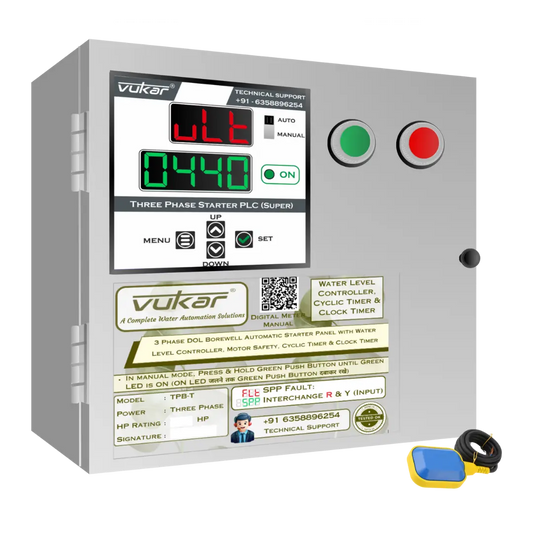
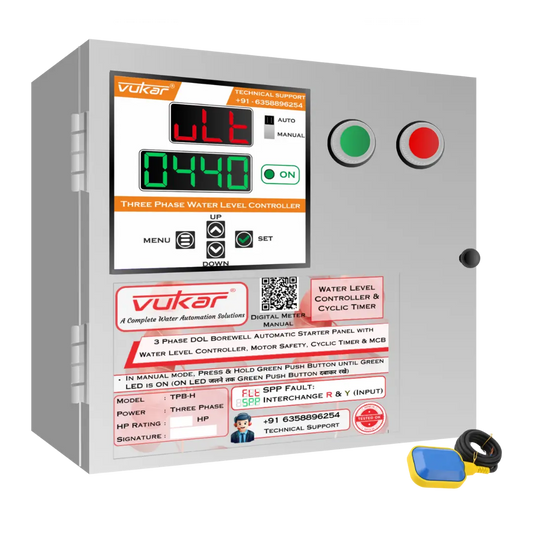
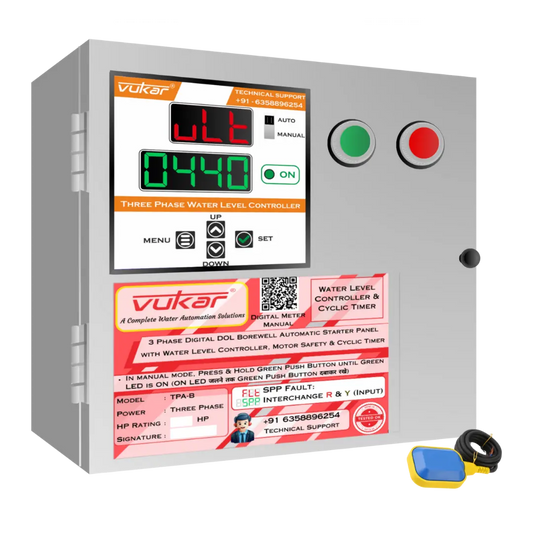
VUKAR's current water level controller family lists wired float arrangements with phase and pump-application distinctions. Single-float models address the overhead tank; double-float arrangements also address a sump. This is a level-control alternative to a basic plug, not a claim that the VUKAR models provide Wi-Fi or work through a third-party smart plug.

Power restoration is a separate test
Find out what happens when supply returns after an interruption. A plug may be configured to return to a previous state, turn on or stay off where its model supports those choices. TP-Link's plug app guide describes default-state settings and notes that features vary by model. Verify the options on the actual device and firmware.
Then consider the pump's own start arrangement. Restoring power to an outlet does not guarantee that a pump needing a separate start action will resume. Conversely, a pump that resumes immediately can run when nobody expects it. Ask the installer to establish the intended power-return response and test it through the documented procedure, with the tank and source conditions recorded.
A level controller also needs this review. Its behaviour depends on sensors, mode, timers and restart settings. Never borrow a restart description from a different controller family. Use the VUKAR product manuals and the actual selected model's documentation rather than treating a general fill sequence as a firmware specification.
Wi-Fi loss and power loss are different
Remote access may disappear while the plug still has power. A local timing function may continue in some conditions, but power restoration can introduce a separate time-synchronisation requirement. TP-Link's schedule FAQ says schedules can work without internet access, while after a power outage its covered devices need internet reconnection to resynchronise time for those functions to continue.
This is why “works without internet” needs its conditions attached. It does not establish that every cloud automation, sensor link or post-outage schedule will work offline. Record whether the proposed stop relies on local wiring, a local device function, a hub or a remote service. Ask what happens if that path is unavailable during filling.
For the full-tank stop, favour a documented local level-control arrangement matched to the installation. This does not make remote monitoring unhelpful. It puts the essential stopping function on an arrangement selected for that job. A phone indication can be convenient, but the final test is whether the real pump stops at the required water level.

Avoid an improvised relay workaround
An electrician can design a control system with separate motor switching, but adding a contactor is not a universal approval for any smart plug. The control circuit still needs the right voltage, load characteristics, enclosure, isolation and protection. The pump circuit needs its own suitable switching and protection. Select both through documentation; do not copy a terminal sketch from an unrelated installation.
Nor should remote control bypass a source-low stop, overload trip or full-tank stop. If remote start is added to an existing system, define it as a permitted request within the intended control logic. The installer should show which conditions can refuse that request. This article compares functions and does not provide a wiring plan or certify a third-party combination.
Purchase check: Ask the supplier two separate questions: “Is this exact device permitted to switch this motor?” and “What information makes it stop when my tank is full?” A positive answer to the first does not answer the second. Keep the written model reference and the installed control arrangement together for future service. The approval should identify the actual pump and supplied device, rather than an unnamed product family.
Bring this information to the installer
Record the pump nameplate, supply phase, starting arrangement and the exact plug's region and hardware version if a plug is proposed. Describe the receiving tank, water source and intended start and stop levels. Include who needs remote access and whether the installation must fill unattended. This makes the control requirement clearer than asking only for a “smart switch for motor”.
During commissioning, observe one normal fill and stop, an applicable low-source response and the agreed power-return behaviour. Test loss of remote access through the supported procedure without defeating protection. Check the actual pump state and water movement. An app showing OFF, an illuminated relay or a timer that has finished is not sufficient evidence on its own.
Use the automatic water level controller buying guide to choose the level-control arrangement. If motor approval for a proposed plug remains missing, leave that plug out of the pump circuit until its supplier confirms the exact application.