Water Tank Level Indicators for Everyday Use
Mohit Vekariaशेयर करना
A water tank level indicator shows when the tank is low, partly full or full. Choose a few marked levels for everyday use. If you need litres remaining, look for continuous measurement and a way to account for the tank shape and the water left below the outlet.
Choose a display for the decision you make
- Fixed probesShow the points where the probes sit. A change between points may not appear yet.
- Float sensorsReport the switch levels. Give the float room to move.
- Non-contact sensorMeasures distance to the surface on suitable models. Confirm geometry and clearance.
Is this a laundry check or a tanker decision?
If you only need to know whether there is enough water before starting laundry, three or four levels may be useful. If several homes share one tank and the caretaker orders water from a tanker, a more detailed reading may help plan the next delivery. Decide who needs the reading and where they will see it. A display hidden in a pump room may be easy to install but awkward to use.
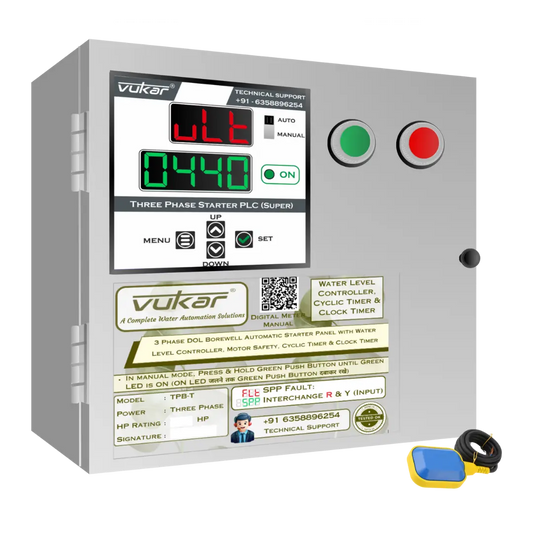
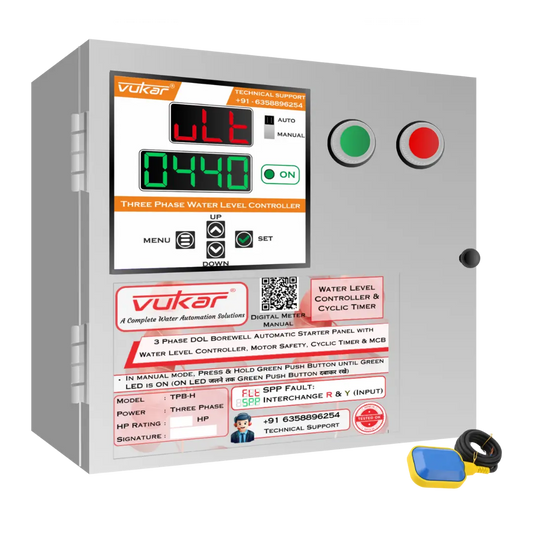
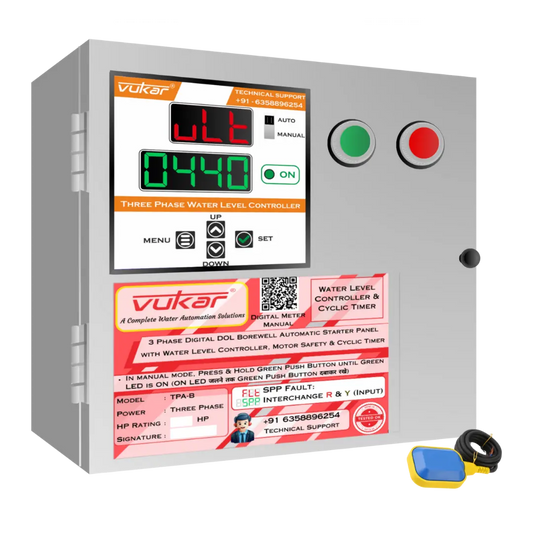
A wired display needs a suitable cable route. Wireless can help when that route is difficult, provided the signal works in the actual rooms and the roof location. Concrete slabs can affect reception. Ask what the display does if the tank unit loses power, its battery goes flat or the link drops. The Aquabrim range gives examples of indicators with alarms and separate controller products.
Half the height can mean different amounts
A straight-sided rectangular tank or vertical cylinder holds roughly half its geometric volume at half its internal water height. A tank with a changing cross-section needs a shape-aware calculation for a reliable litres figure. A display that has only four switches can only tell you when water has passed those points. It may show the same level for a while as water is used.
For example, if a 1,000 L vertical cylinder with straight sides reads 50% of its calibrated water height, it may hold about 500 L within that range. Your usable amount above the outlet can be less. Use the water tank calculator with internal dimensions to relate a height reading to an estimated volume.
Calibrate for what you can actually use
Imagine a vertical straight-sided tank that holds 1,000 L across the full calibrated range. At a 50% level it holds about 500 L. If the usable outlet sits above the bottom 80 L, roughly 420 L can flow out by that outlet. The calculation assumes straight sides. For an irregular tank, use its volume chart or calibrate against known fills.
Test the reading where it matters
Have the installer check each displayed level during a controlled fill or using the manufacturer’s test method. Ask about the low-level alert, sensor cleaning and what happens after a power outage. Keep a record of the sensor locations and how to isolate equipment for service.
Label the display if it serves more than one tank. A reading marked “low” means little until everyone knows whether it refers to the sump or the overhead tank. Use the same names at the display and near the corresponding valves.
For two tanks, use the same names on the display and beside the valves. Test the low alert and what the display shows after loss of power or signal.
If a red light is enough to remind someone to start the pump, an indicator can do the job. If the pump must respond even when the house is empty, use the controller buying guide to choose a suitable automatic system.