Cooler Cyclic Control: Check the Fan and Pump Separately
Mohit Vekariaशेयर करना
A cooler can use cyclic control when its operating plan calls for repeated ON and OFF periods. Before selecting a starter, identify whether you are controlling the fan, the water pump or both. The cooler's supply phase does not remove the need to assess each motor and its control sequence.
The first question: what should stop?
A request to “run the cooler on a timer” can hide two different jobs. Stopping the fan interrupts airflow. Stopping a water pump changes water delivery while the fan may continue. Switching both together creates another sequence.
Mohit Vekaria supplied cooler operation as an application similar to cyclic ventilation and noted that it may be single or three phase. The exact fan/pump arrangement still needs confirmation. This guide therefore describes the selection process without assigning one universal cooler model.
What cyclic control changes
Manual operation requires someone to issue each repeated start and stop. A cyclic timer can repeat the approved running and resting periods locally.
That benefit depends on the process tolerating the OFF period. A fixed timer does not measure temperature, humidity, pad wetness or airflow. If those conditions must determine operation, a separate supported sensing and control design may be needed.
Which VUKAR panel may be relevant?
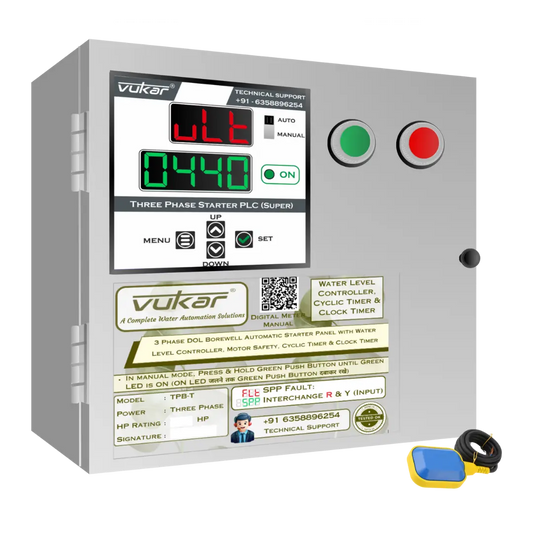
For a compatible three-phase DOL motor, TPM-A is a cyclic starter-panel candidate. Its ON/OFF adjustment is in minutes. Confirm the actual motor duty, contactor suitability and permitted starts before applying pump-oriented specifications to a cooler fan.
For a single-phase water pump, select the correct pump family and starting circuit. A compatible borewell/openwell arrangement may lead to BOM-G; a monoblock or openwell arrangement may instead call for its own MOM or OPM cyclic family. These are conditional candidates, not interchangeable wiring arrangements.
For a single-phase fan, do not assume that a pump panel's capacitor/start circuit will match. Obtain explicit fan-motor compatibility confirmation first.
Where built-in motor protection helps
Use the selected starter's documented motor-protection functions with the correct settings. Protection for a pump load may require different assessment from protection for a fan; for example, a pump dry-run function is not proof of airflow monitoring.
If the cooler has two motors, do not assume one timer panel independently protects and sequences both. Specify separate motor protection and any required interlock or staging.
Before commissioning
Give the installer each motor's nameplate, the proposed cycle and the required sequence between fan and pump. Test the normal stop, documented fault response and power restoration.
If the real requirement is continuous ventilation with only temperature-based water control, a simple whole-cooler cycle may be the wrong approach. Choose the operating rule first, then the panel that can carry it out.