
Why an MCB Trips at Night or at the Same Time Each Day
VUKARIf a circuit breaker trips at night, a timed appliance, several loads running together, or conditions around an outdoor circuit can produce the pattern. The clock is a clue, not a diagnosis. An MCB responds to overcurrent; it does not know whether it is night. Record what was operating and which device actually opened before blaming the breaker, the pump, or the electricity supply.
A useful investigation separates three times: when equipment started, when power disappeared, and when somebody noticed. A pump may stop at 23:00 while the household discovers the outage at 06:00. Calling that a 06:00 trip sends the investigation in the wrong direction. You can collect this information without opening the distribution board or deliberately recreating a fault.
First identify which protective device tripped
The switch people call an MCB may actually be an RCCB or RCBO. An MCB protects against overcurrent. An RCCB detects an imbalance associated with current taking an unintended path; it does not replace overload protection. An RCBO combines those functions. Read only the accessible front label, or give an electrician an existing photograph. A test button is useful identification evidence, but the complete model reference matters.
If one room loses power, note whether its branch device moved. If the whole property loses power, record the main device as well. A dark house with every handle unchanged may involve a supply interruption or another upstream device. The visible position alone cannot identify every fault. Our MCB and RCCB comparison explains the different protective jobs.
Do not remove covers to trace the circuit. A short description such as “main device opened, kitchen and pump both stopped” gives the technician more useful information than “the electricity went again.”
Keep a load diary that records events rather than guesses
Write down the date, the best confirmed outage time, the affected circuit, and the equipment known to be operating. Add whether a load had just started or had run for a while. Record rain, irrigation, power restoration, and timer changes only when they actually occurred. Mark unknown details as unknown. A precise diary can be a notebook; it does not need a connected monitoring system.
Do not stand beside a suspect installation waiting for it to trip. Use normal observations from a safe location. Appliance clocks resetting together, a controller's existing event history, or a message from somebody present may narrow the time. Their clocks may disagree, so record the source of each timestamp. Keep the diary available for the electrician rather than turning uncertain recollections into firm facts.
| Observation | Record this useful detail |
|---|---|
| Same clock time | Which timer or automatic load was due then? |
| After a similar running period | Start time and elapsed time before the outage |
| After rain or irrigation | Which outdoor equipment was already in use? |

Look for scheduled equipment and coincident demand
Water pumps, water heaters, outdoor lights, irrigation equipment, and charging equipment may run automatically. A schedule can create a repeatable load pattern even when nobody touches a switch. Two individually normal appliances starting together can produce a different demand from either running alone. Refrigerators and other cycling loads can join that pattern without following an exact daily schedule.
For a simplified single-phase example, four simultaneously operating loads drawing 6 A, 7 A, 5 A, and 4 A total 22 A through their common supply path. These are invented teaching figures, not measurements or a recommendation for a breaker rating. Actual current, duty, cable capacity, ambient conditions, and protective-device characteristics still need assessment.
Compare the diary with the schedules already in use. Do not repeatedly restart suspect equipment to prove a coincidence. If a timer was recently edited, record the old and new settings if known. A changed schedule can explain why an established installation developed a new evening pattern without proving that its electrical protection is suitable.
Distinguish an immediate trip from heating over time
A trip close to a motor start raises different questions from a trip after sustained operation. Starting current, a fault, cumulative demand, and a poor connection can all require investigation. Timing narrows the questions; it does not identify the failed component. Schneider Electric's breaker troubleshooting guidance distinguishes startup events from trips after operation and calls for load and connection checks.
Consider an illustrative diary: a heater starts at 21:30 and the breaker opens at 22:10. That does not prove the heater has a short circuit. The technician needs to examine the current over that interval and the relevant circuit conditions. A breaker can heat because of an overload, while a high-resistance termination can also produce abnormal local heating.
A cool morning inspection may miss a short evening peak. Tell the electrician when the event normally occurs so suitable logging can be planned. Do not feel terminals, tighten connections, or change a breaker yourself to investigate heat.
Treat outdoor conditions as evidence, not a verdict
If an MCB trips overnight after rain, record the connection between the events without calling moisture the confirmed cause. Water can damage insulation or equipment, but an ordinary MCB is not a dedicated moisture detector. A residual-current device may respond to leakage that an MCB alone would not detect. Correctly identifying the opened device is especially important here.
A pump cabinet near a tank, an outdoor light, or a cable route exposed to irrigation deserves attention from the electrician. Record visible external damage from a safe distance. Do not open a wet cabinet, touch a wet motor, or unplug equipment while standing in water. The absence of obvious water outside does not establish that the inside is dry.
Weather can also coincide with unrelated demand changes. For example, an evening shower may occur while a heater and pump operate together. Keep both observations in the diary. Let measurements and inspection distinguish the possibilities instead of selecting the most noticeable event as the cause.

What a competent electrician needs to check
Give the electrician the device reference, circuit description, diary, motor nameplate details already available, and recent changes. Useful checks can include current over time, the relevant trip characteristic, cable and termination condition, insulation, and the actual connected load. The method depends on the installation and must follow safe isolation and suitable test procedures.
The supply also deserves consideration where the evidence points that way. A motor struggling to start may involve supply conditions, its starting arrangement, mechanical loading, or a motor fault. Do not describe every low-voltage suspicion as a confirmed supply problem. Measurements must capture the relevant event and be interpreted against the equipment's requirements.
Ask for the diagnosis and corrective work to be recorded. “Changed to a bigger MCB” is not an adequate explanation unless the whole circuit design supports the change. The protection must remain suitable for its cable and fault conditions. Our overload and short-circuit guide explains why the cause matters.

Keep pump control settings separate from electrical protection
A pump timer can determine when a motor is requested to run. It does not make an overloaded feeder safe or replace correctly selected short-circuit and overload protection. If the nightly event follows a pump schedule, document the command time and observed motor behaviour separately. A command to start is not evidence that the motor reached normal running speed.
With several automatic loads, review schedules for unintended overlap. Set times carefully and allow for the actual operating pattern. Avoid claiming that staggered settings repair damaged insulation or a loose connection. They may change simultaneous demand, but any discovered fault still needs correction before normal operation resumes.
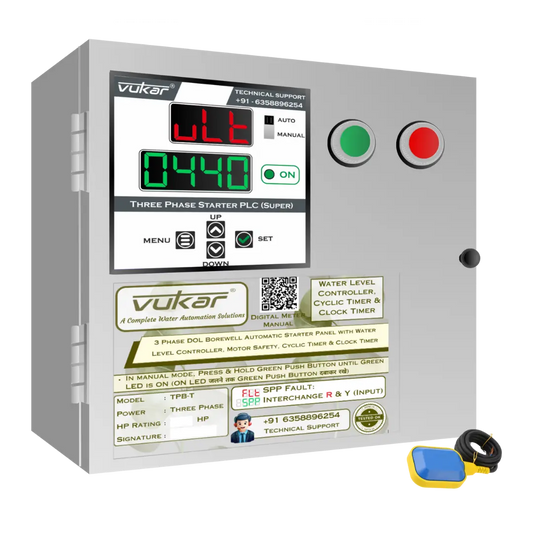
If a replacement starter is being considered, compare its documented motor range, protection functions, and installation requirements with the actual pump. A product description is a starting point for selection, not a diagnosis of the existing board. The related starter shown here is relevant to pump-control planning only.

Turn the diary into a clear next step
Before the visit, summarize the strongest observation in one sentence: “The main device opens shortly after the 22:00 pump command,” or “The outdoor branch opens after irrigation, but the exact time is unknown.” Attach the diary rather than adding an unverified explanation. Include whether the problem began after a new appliance, a repair, or a schedule change.
After corrective work, ask what was found, what changed, and how normal operation was checked under relevant conditions. One quiet night is useful observation, but it cannot by itself prove that every possible fault has gone. Keep a short record of ordinary operation without deliberately stressing the circuit.
Your next action is to identify the actual device and preserve a reliable timeline. If warning signs or repeated trips are present, arrange professional help promptly instead of waiting for a longer diary. A clear record helps the electrician find the cause while keeping you out of the electrical enclosure.