
Agricultural Submersible Pumps in India: What Drives Demand and Replacement?
Mohit VekariaAgricultural submersible pump demand in India comes from new irrigation installations, replacement of worn or failed equipment, and changes such as efficiency upgrades. Each purchase needs local water-source and electricity information. A market-growth figure alone cannot tell a farmer or dealer which model is needed.
For a dealer or manufacturer, understanding the reason for the order is more useful than assuming every pump sale means a new borewell.
| Reason for purchase | What the buyer should establish |
|---|---|
| New irrigation installation | Water availability, required flow and working head. |
| Replacement after wear or failure | The original cause and whether the duty has changed. |
| Efficiency upgrade | Comparable water delivery and operating evidence. |
| Change in operating needs | The required power-return, timing and source-water behaviour. |

New irrigation needs begin with the water source
A farm planning irrigation must match its water demand with the water it can responsibly obtain. Crop area, irrigation method, available pumping hours and source recovery all influence the pump duty.
A borewell's drilled depth does not by itself show its sustainable output. A pump should not be sized to remove water faster simply because a larger motor is available.
The Central Ground Water Board's 2025 resource assessment provides context on India's groundwater resources. A purchase still needs local source information and the relevant permissions and restrictions for that location.
Replacement demand has several causes
Some pumps need replacement after long service. Others fail because of unsuitable operation, electrical problems or a poor original selection. A replacement quotation should establish which situation applies.
Ask what changed before the failure. The pumping water level, pipe condition, cable and supply may differ from those at the first installation. Replacing the pump with the same model may not resolve a changed duty.
Keep the failed equipment's records where available. They help the installer distinguish a pump problem from a fault in the starter, wiring or water source.
Efficiency upgrades are a separate part of demand
A farmer may replace a working pump to reduce unnecessary energy use or better match the irrigation task. That choice needs evidence from the whole pumping system.
The Bureau of Energy Efficiency's agricultural demand-side programme includes replacing inefficient agricultural pump sets with energy-efficient models and building technical awareness.
For an individual farm, compare performance at the required duty. A new pump's efficiency claim does not show the saving unless the old and new systems are compared on the same water-delivery task.
Local supply conditions shape the product choice
Record the available phase and the actual electricity conditions with the installer. The motor, cable, starter and protection must work as one arrangement. A wide-voltage claim should be checked for the exact model and installation conditions.
Also record how the farm wants the pump to behave after a power cut. Automatic restart, a fixed schedule and a manually supervised start are different operating choices.
Seasonal use needs a service plan
A pump used intensely during one part of the year may have long idle periods too. Follow the maker's instructions for inspection and returning the system to service. Do not wait for a critical irrigation day to discover a damaged cable or an unsuitable setting.
For buyers, ask where repairs and spares will come from. For dealers, keeping accurate motor and control records can make support more useful than simply offering another HP size.
Control features should solve a real farm task
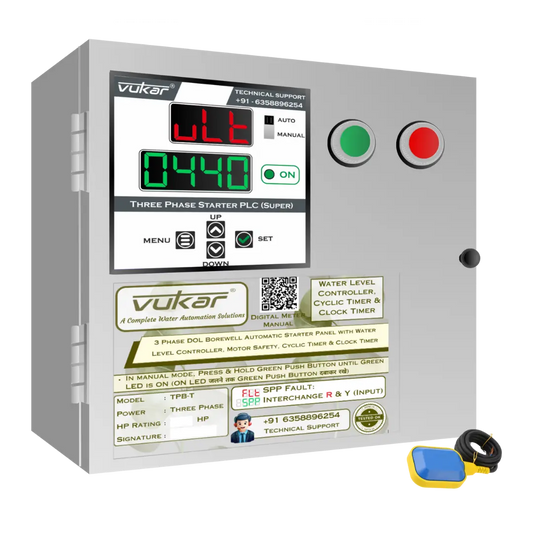
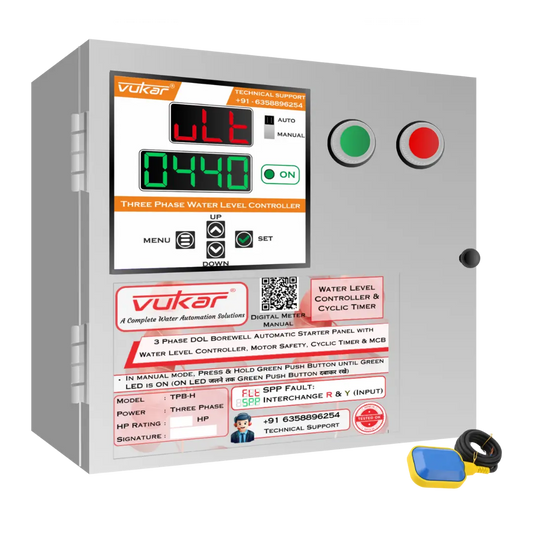
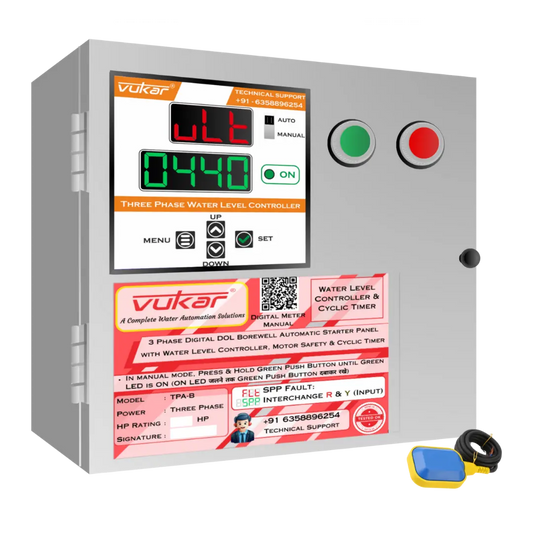
A cyclic timer may help schedule run and rest periods in a supported application. It does not measure a borewell's recovery by itself. A dry-run stop and its restart rule also need proper setup.
Use the low-yield borewell timer guide to understand that distinction. Have the installer test the chosen behaviour against the motor's permitted operation.