Sump to Overhead Tank: Stop Pumping When Either Tank Needs It
Mohit Vekariaशेयर करना
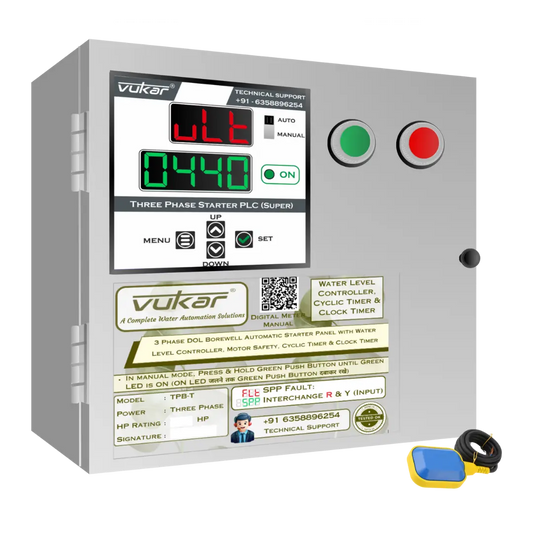
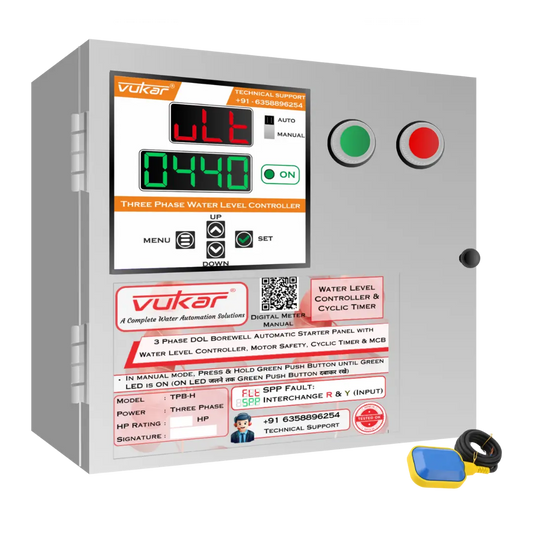
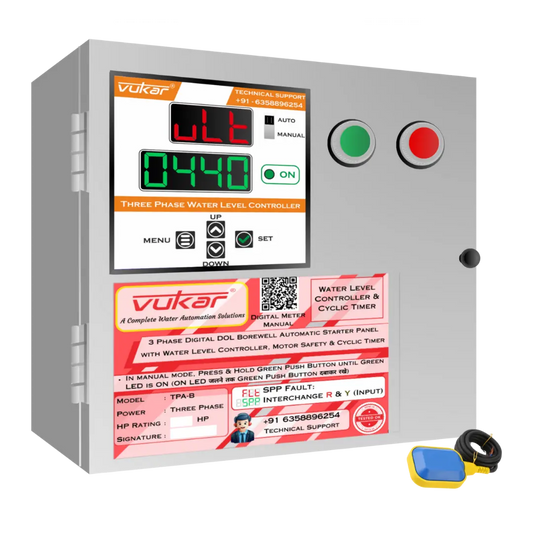
A sump-to-overhead-tank pump needs permission from both ends: the roof tank must need water, and the sump must have water available. Choose a starter-panel arrangement that verifies both conditions if you want both functions. Two floats in a product photograph do not, by themselves, prove that sequence.
The problem a roof-tank stop does not solve
An overhead-tank full signal can stop further filling. It cannot establish the water level in the underground sump. If the source empties first, the pump needs a separate supported way to stop or inhibit operation.
This matters where sump supply is irregular. Someone may start the pump while water is available, then leave before the source becomes low. Automating only the destination leaves that operating condition unresolved.
Write the required sequence before selecting a panel
The functional brief should say:
- Start only when the destination needs water and the source permits pumping.
- Stop when the overhead tank reaches its full threshold.
- Stop or inhibit pumping when the sump reaches its low threshold.
- Resume only under the documented source-recovery, demand and protection rules.
These are selection requirements, not a claim that every VUKAR level panel implements them identically. Confirm which sensor reports each condition, the separation between start and stop thresholds, and the response to an invalid signal.
Suitable VUKAR panel families
For a compatible single-phase openwell pump, start the assessment with OPA level-control panels. For a compatible single-phase monoblock pump, assess MOA. For three-phase openwell or monoblock duty, assess TPA-O/TPO-H/TPO-T variants.
The exact model recommendation remains conditional until its wiring diagram and source/destination logic match the required sequence. Motor phase, rated current, starting circuit and switching duty must also match. Do not select a borewell capacitor arrangement simply because its HP label resembles the transfer pump's rating.
Level sensing and motor protection do different jobs
A source-low input can prevent an attempted run under the condition it detects. Motor-current-based dry-run protection, where fitted, responds to a different signal. Neither should be casually substituted for the other in the specification.
The starter's motor-protection functions must be configured for the installation. They do not replace appropriate circuit protection or correct a blocked pipe, leaking valve or damaged pump.
A useful commissioning test
With a qualified installer, verify each stop condition separately, then confirm what happens when demand returns, source water returns and power returns. Check that a source recovery does not cause unwanted repeated starts.
The benefit is fewer routine trips between tanks and a clearer operating sequence. If you need several sumps, several destination tanks or priority sharing, obtain a specific control design rather than extending a two-condition example by assumption.