Add Automation to an Existing Starter—or Replace the Panel?
Mohit VekariaShare
If your existing starter is sound and suitable for the motor, adding a documented compatible control may be reasonable. If the starter itself is unsuitable, damaged or missing essential functions, assess a complete replacement panel first. Decide from the installation, not just the cost of a small device.
Describe what you want to add
“Make it automatic” can mean several things. You might need a timed stop after manual starting, repeated ON/OFF cycles, fixed clock hours or tank-level response. A device that solves one does not necessarily solve the others.
Also list the protection already present and what is missing. A timer relay should not be credited with motor protection simply because it can stop the motor.
When a complete panel is the clearer option
A complete phase-matched starter can provide the required switching, supported protection and chosen operating functions in one specified assembly. It is the priority for a new installation or an existing starter that needs substantial rebuilding.
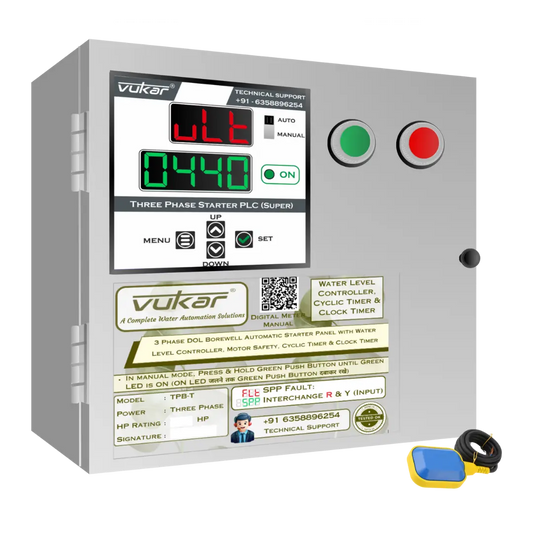
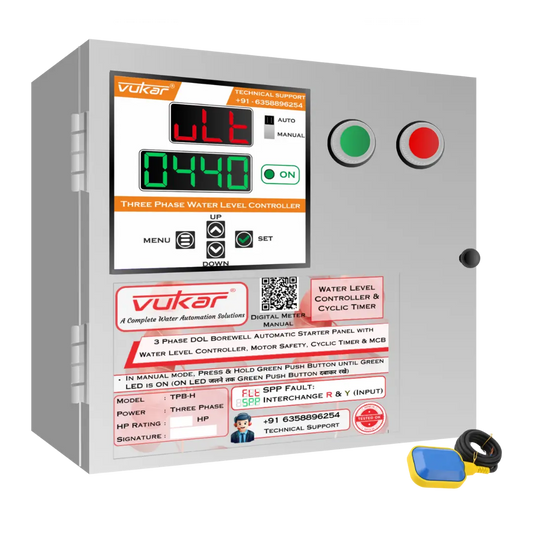
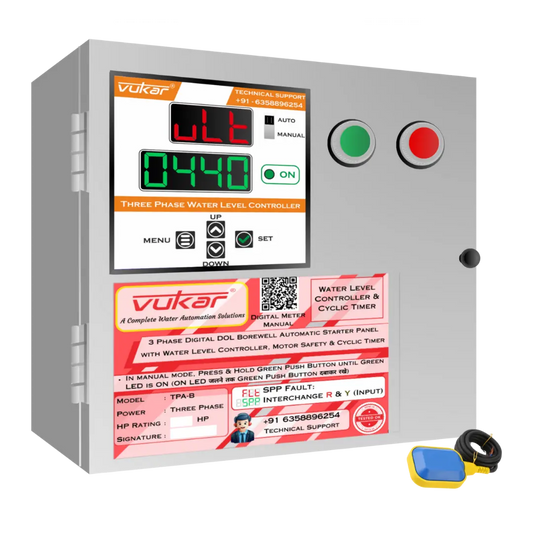
For compatible borewell/openwell single-phase motors, BOM-G and BOM-T are cyclic and clock-family candidates. For compatible three-phase DOL motors, assess TPM-A or TPM-T. Level-based filling calls for a level-control panel instead. Select the exact variant rather than treating these names as interchangeable.
A replacement still needs appropriate circuit protection, installation and commissioning. “Complete panel” does not mean that every variant includes an MCB, sensors or every possible accessory.
When a device retrofit may be appropriate
A control device can be considered when the existing contactor, overload arrangement, enclosure and wiring are suitable and the new function has a documented interface.
VUKAR DEV-K cyclic/clock options and DEV-P three-phase options are examples of device families to assess for specific integrations. They are not automatic substitutes for an entire starter. Their current-sensing ranges, supply requirements and control outputs must match the particular model and circuit.
Have an electrician review the actual diagram, contactor-coil voltage, start/stop circuit, existing interlocks and permitted restart behaviour. Motor HP alone cannot establish retrofit compatibility.
Compare the whole installed scope
Count the device or panel, required contactors or interfaces, enclosure work, wiring, sensors, installation and testing. Retaining a good panel may reduce unnecessary replacement. Retrofitting an unsuitable one may create extra work without a dependable result.
A useful illustration is a healthy starter that lacks only a supported clock command. That can justify a retrofit assessment. A starter with damaged switching parts and no suitable protection is a different case; do not treat the cheapest add-on as a repair.
Before approving the change
Ask for the final control sequence and a list of retained and added functions. Test normal stopping, protection response, manual control and power-return operation. Keep the updated wiring record with the panel.
If the starter already meets the requirement, the right answer may be to keep it as it is.