
Automatic Garden Irrigation Without a SIM Card
Mohit VekariaShare
If your garden needs a set amount of watering time each day, the practical question is who will start and stop the pump. TPM-T can handle that routine locally for a compatible three-phase pump. In its daily-runtime mode, a power cut pauses the day's allocation: when suitable power returns, the pump completes the remaining time, then stops until the next day.
Start with the watering routine
VUKAR describes farmhouse and garden owners who switch irrigation pumps by hand, or use a SIM-based starter or auto switch. For a repeatable daily routine, the aim is straightforward: set the required operation and let the controller handle routine starts and stops.
A 30-minute or three-hour daily requirement is a programming example, not a watering recommendation. The right duration depends on the irrigation system and the garden's actual needs.
A clock window and a daily runtime are different
- Clock window: run during a chosen daily period, such as a morning watering window.
- Repeating cycle: run, rest and repeat for the configured ON/OFF periods.
- Daily runtime target: complete a specified amount of motor running time as suitable power becomes available.
Before setting the timer, decide which rule you need. A clock window defines when the pump may run. A daily-runtime target defines how much running time it should complete. VUKAR confirms that TPM-T's daily-runtime mode resumes only the remaining time after a power cut and stops until the next day once the target is complete. Do not assume the same recovery rule applies to every timer mode.
How the control methods differ
| Approach | When it fits | Main constraint |
|---|---|---|
| Manual starter | Someone can attend each watering period | Routine on-site intervention |
| Auto switch without scheduling | Starting on healthy supply return is the main need | Does not establish a daily watering window |
| SIM-based control | Off-site pump commands are needed | Check the selected service, coverage and plan |
| TPM-T local timing | The watering routine can be programmed locally | Select the correct timer mode and pump configuration |
| Sensor-based irrigation control | Watering must respond to soil or weather | Needs compatible sensors, valves and interfaces |
What TPM-T controls
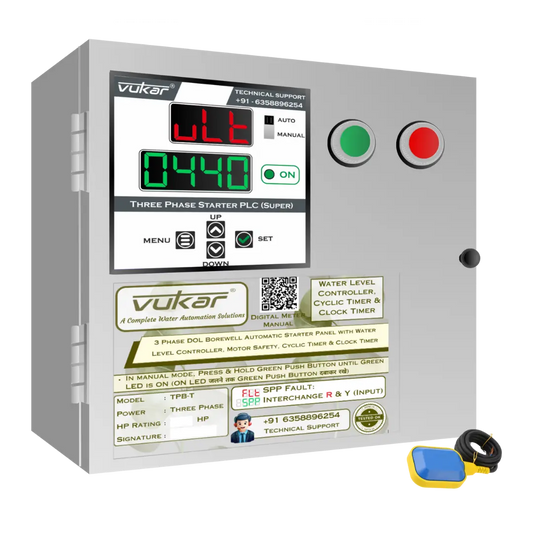
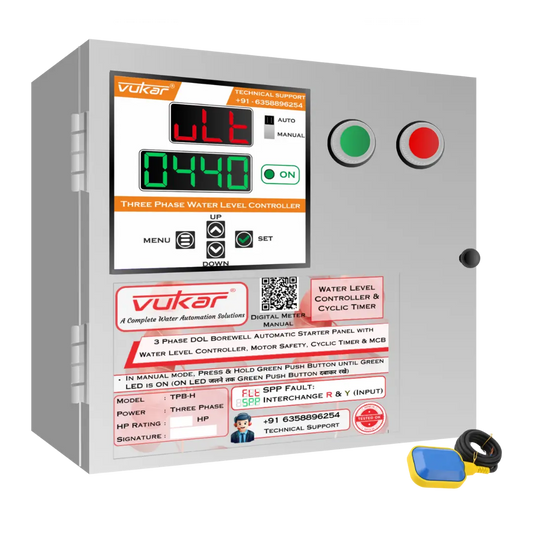
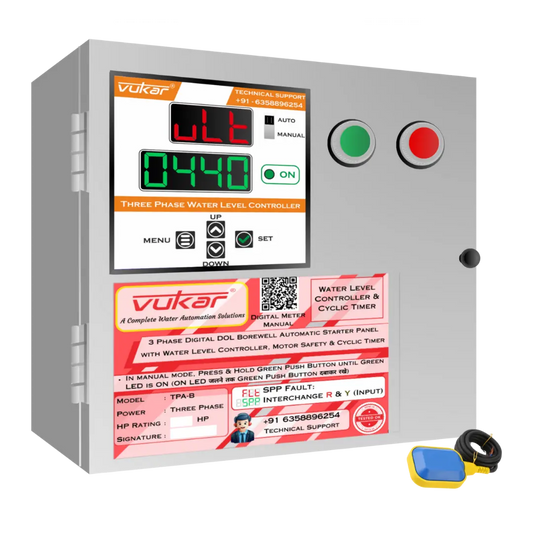
TPM-T is a three-phase direct-on-line (DOL) pump starter with clock and cyclic timers and an auto switch. Its product page lists variants up to 10 HP and overload, dry-run, high/low-voltage and phase protection. Match the actual variant and current settings to the motor; a maximum HP figure is not a setting to use for every pump. [1]
For a routine programmed locally, the timer does not need a SIM card or a phone command for each watering period. That removes the SIM plan from this local control arrangement. It does not provide remote commands, alerts or proof that water reached the plants; those are separate requirements.
Timing and motor protection do different jobs. The timer requests starts and stops. The supported protection functions respond to the faults they are configured to detect. Routine automation does not remove the need for source checks, maintenance or fault investigation.
What happens during a power cut?
Take an illustrative 30-minute daily target. The pump runs for 10 minutes, then the power fails. When suitable power returns later that day, TPM-T resumes the remaining 20 minutes. After completing 30 minutes in total, it stops until the next day. It does not begin a fresh 30-minute allocation.
The same principle applies to an illustrative three-hour target. Completing it still depends on enough suitable power, an available water source and the absence of a fault that prevents operation. During setup, test a power interruption and check the day-change behaviour if operation may extend overnight.
What a local timer does not cover
- For a single-phase pump, select an appropriate single-phase model rather than TPM-T.
- If an existing compatible starter and protection are adequate, adding suitable timing control may be sufficient.
- For moisture-, rain- or flow-based watering, use a compatible irrigation control system with the required sensors and interfaces.
- For multiple irrigation zones, assess valves and zone sequencing separately; a timed motor starter does not establish zone control.
- For remote monitoring or commands, compare a communications-enabled solution instead of treating a local timer as a remote-control substitute.
Checks before setup and use
Check the pump nameplate, supply type, existing starter and intended operating rule. Confirm the exact TPM-T variant, water-source conditions, circuit protection, timer mode, clock retention and behaviour after a motor fault. Use the model's instructions for the actual button sequence and parameter names; a clock timer and a daily-runtime setting should not be treated as interchangeable.
Once configured, observe a complete operating sequence and test recovery after a power interruption. Check that the intended watering occurs, rather than relying only on an ON indication. The running-time target describes motor operation; it does not measure the amount of water delivered.
Sources and related reading
[1] VUKAR TPM-T product specifications
Related guide: Cyclic, Clock and Auto-Off Timers
Related guide: Starter Panel Selection
If your pump matches the phase, motor rating and timer requirements explained here, you can view the TPM-T product options.