Low-Yield Borewell: Can a Cyclic Timer Help the Pump?
Mohit VekariaShare
A cyclic timer can give a borewell pump planned running and resting periods. It may help where operation needs a repeatable run/rest routine, but it cannot increase borewell yield or confirm that water has recovered. First establish why delivery falls and whether the pump can tolerate the proposed starts.
What happens when water stops arriving?
A borewell that delivers water initially and then loses flow may have limited available water. Similar symptoms can also involve the pump, pipework, valves, supply or installation. Do not treat the symptom as a confirmed recharge problem without checking.
Repeatedly restarting after a dry-run trip is not a diagnosis. Record the observed delivery pattern and any fault indication, then have the cause assessed. The useful question is how much water can be drawn sustainably under the site's conditions, not how often the starter can be reset.
Planned rest and dry-run protection are separate
Cyclic timing stops the pump after a configured ON period and permits another run after the OFF period. The rest interval is only elapsed time. It does not measure the water column.
Supported dry-run protection can trip when the model's detection criteria are met. Its detection method, settings and retry behaviour need to be checked in the exact manual. Do not assume that a cyclic restart overrides a fault, or that every dry-run trip restarts automatically.
Where BOM-G or TPM-A may fit
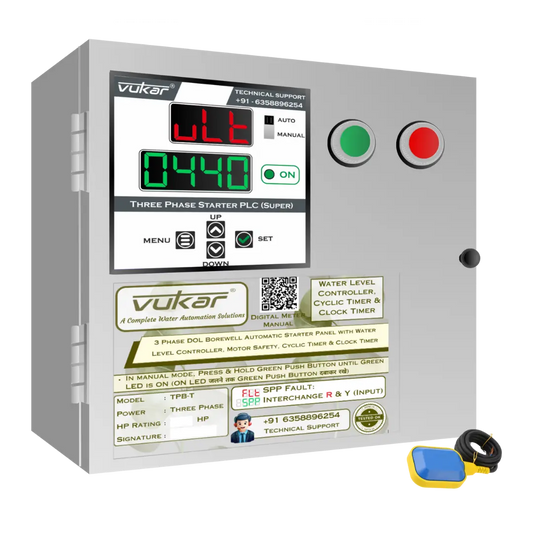
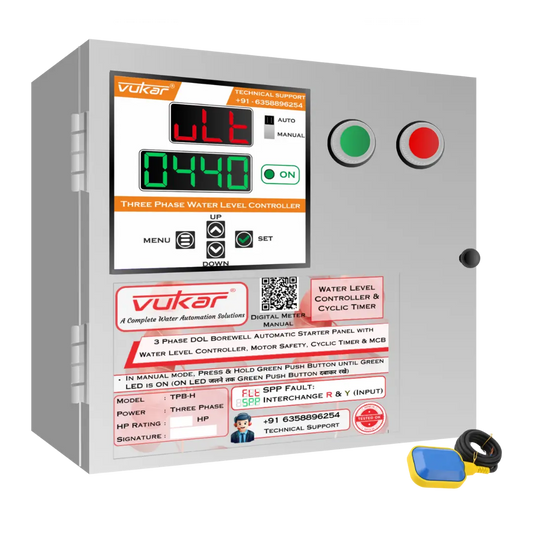
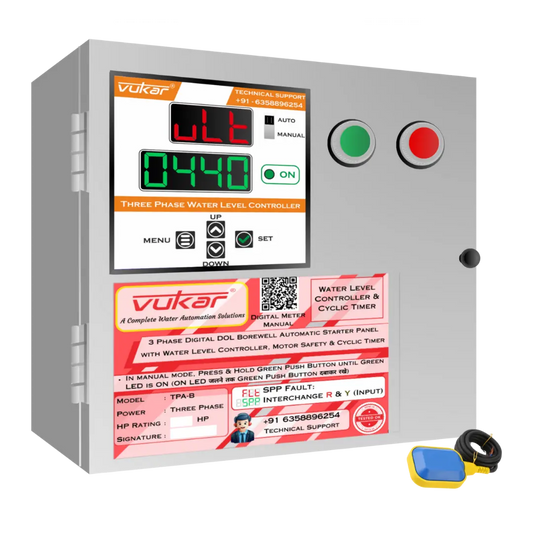
For a compatible single-phase borewell/openwell motor, BOM-G is the cyclic-timer starter-panel candidate. For a compatible three-phase DOL motor, TPM-A is the candidate. The supplied motor protection is part of the panel assessment, alongside its timer.
Match the actual HP variant, rated current and starting arrangement. A timer mode suitable for one pump is not evidence that frequent cycling is acceptable for another. Where the requirement is fixed clock hours instead, assess the clock-timer family separately.
Choose settings from the site, not a universal recipe
Ask the pump supplier or installer about minimum run time and permitted starts. Observe water delivery and recovery over representative conditions. A sequence that appeared adequate once may become unsuitable as source conditions change.
If demand exceeds sustainable yield, storage, demand scheduling or another water-source strategy may be more important than a new starter. The panel does not solve that water-balance problem.
What should the final check demonstrate?
Commission the planned cycle, documented dry-run response and power-return behaviour without bypassing protection. Confirm how an unsuccessful restart is handled and how an operator learns that water is unavailable.
The practical benefit is a consistent operating routine with supported fault response. It is not a promise of more borewell water or uninterrupted supply.